
Che Fu named 2026 NZ Music Hall of Fame Inductee
Che Fu named 2026 NZ Music Hall of Fame Inductee
Recorded Music NZ have announced Che Fu as the 2026 NZ Music Hall of Fame inductee. Che will be formally inducted into Te Whare Taonga Puoro o Aotearoa | the NZ Music Hall of Fame at the 2026 Aotearoa Music Awards, on Thursday 28 May.
A pioneer of conscious hip hop in Aotearoa, Che Fu (Che Ness) is of Niuean and Māori descent, and weaves Pasifika and te ao Māori through his recordings in a truly unique way. Born and raised in Grey Lynn, Tāmaki Makaurau, he is one of the most significant local artists of his generation. Che Ness was made a Member of the NZ Order of Merit for services to music in 2009. He was awarded the Pacific Music Awards Lifetime Achievement award in 2014.
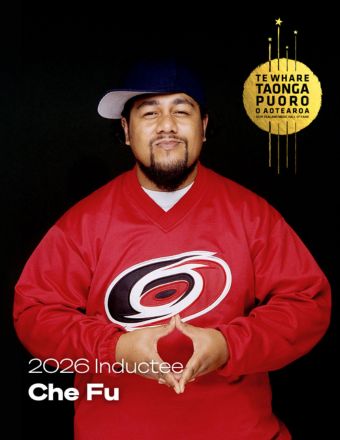 Che had already found international success fronting 2014 Hall of Fame inductee band Supergroove as a teen, before launching his own incredible solo career. A pioneer of conscious hip hop in Aotearoa, his music remains embedded in the nation’s musical consciousness with his chart-topping classic tracks Chains (Platinum), Misty Frequencies (Platinum x4) and Fade Away (Platinum x3) still enjoying high airplay.
He fronted Supergroove alongside Karl Steven, from age 15 – 21. Not long after his exit from the band came the runaway success of a special track his friend and mentor Darryl Thomson, aka DLT, had pushed him to co-write and record. Chains remains one of the biggest singles to come out of Aotearoa. Offered an album deal with BMG, Che worked with Kirk Harding and Phil ‘Sir-Vere’ Bell, recording his critically acclaimed 1998 debut album ‘2b S.Pacific’ with Andy Morton, aka Submariner.
Released in 2001, Che’s breakthrough second album ‘Navigator’ melds hip hop, R&B and reggae, with elements of rock. He recorded, mixed and engineered ‘Navigator’ himself at Revolver Studios, alongside studio engineer and producer Neil Baldock. It debuted at #1 on the Aotearoa Top 40, and won five Tūī awards plus that year’s People’s Choice award – as well as the 2002 APRA Silver Scroll (with Godfrey de Grut) for Misty Frequencies. The album turns 25 this year, with a limited edition 25th anniversary silver vinyl reissue due for release on 22 May.
With an impressive cohort around him, many of whom remain close friends and collaborators, including the members of his longtime band The Kratez, Che’s story is one of both independence and community. He was uniquely positioned to do this, having grown up as a Polynesian Panthers kid raised on music, Rastafarianism and politics.
Overall, Che’s career has strong familial roots. His father Tigilau (Tigi) Ness is a Tūī-winning Niuean NZ artist, who has helped to shape the roots reggae genre in Aotearoa since his early days as a founding member of Rastafarian church and band The Twelve Tribes of Israel, and as Unity, which became Unity Pacific, in the 1970s. Tigi joined the Polynesian Panthers in 1972 and Che Fu’s mother, the late Miriama Rauhihi Ness (Ngāti Whakatere, Ngāti Taki Hiku) was also a prominent member of the Polynesian Panthers and a key organiser of the historic 1975 Land March, as well as a driver of the 1972 Māori Language Petition that led eventually to te reo Māori becoming an official language of Aotearoa in 1987. Tigi is still active as a performer, activist and educator. He often performs with Che as a member of The Kratez.
His parents’ social justice influence can be heard through Che’s music, shaping its lyrical content as well as his stylistic approach. Che preferred conscious hip hop to gangster rap, and was singing bilingually long before waiata reo Māori was as celebrated as it is today. He quietly but firmly made political statements through simply describing the world as he knew and experienced it.