
Merv Pinny: Hoeing The Hard Road
Merv Pinny: Hoeing The Hard Road
Merv Pinny bought his first guitar at 10, and five decades on it’s evident that making music is still what he most loves to do. 2025 sees him releasing ‘Hard Road’, remarkably only his second album in a career studded with numerous globally successful singles. Musical success can be hard to measure, but being a five-time semi-finalist of the Nashville-based International Songwriting Competition points to the fact he knows how to write a very good tune. Pinny talked with Richard Thorne ahead of the album’s November 2025 release.
Merv Pinny’s first taste of musical success came back in the 1990s, with a single called Lonely Woman, and a wave of publicity that played heavily on the fact he was a songwriting dairy farmer, who wielded a mean guitar in his spare time, and likely sang to his cows in the milking shed.
Although he attributes many aspects of his musical success since to luck, it’s more luck of the bad kind that meant Pinny never got to take the shot at fame that seemed his destiny in 1994, on the back of releasing his debut album, coincidentally of that name.
Recorded at Auckland’s top end Airforce Studios, his ‘Destiny’ album (and matching single) saw Pinny a 1995 NZ Music Awards’ Country album finalist, beaten for the Tui by the enduringly popular Kevin Greaves.
With a sound that fitted into the hugely popular American country rock scene of the time, and optimistic confidence of a “bulletproof” motorbike-riding, successful young farmer, he was now a recording artist, with an album released on a local label distributed through Warner Music, and a publishing deal with Sony.
Chatting over coffee in his Northland studio he shares an anecdote from those freewheeling times that involves the late TV music journalist who has given his name to IMNZ’s Taite Music Prize. Dylan Taite had recorded one of his late night news stories about Pinny, but the budding Kiwi artist was thwarted by revelations about Michael Jackson then dominating the world’s music news. Pinny kept pestering the friendly reporter. After hearing of his plans for a music video, Taite told him the idea was lame, then offered his own services as a videographer.
“I was like, really? And Dylan said, ‘Yeah, I’ll make a video’, and the really impressive thing about him was that he had all these ideas!”
Borrowing a mate’s vintage car, they shot one scene in a cafe in Te Aroha where he was farming back then. Pinny was playing a role, and his ‘girlfriend’ was supposed to get angry with him and storm off. He recalls Taite causing quite a scene himself when he suddenly yelled wildly at her – in coaching the actress how to be more explosive.
“I’d never heard him raise his voice once before, everyone there was shocked because he was always so polite! But anyway, Dylan shot the video, and later he sneaked me into TVNZ to shoot some other scenes. Everybody was away on summer holiday, but he said it would’ve been big trouble if anyone knew, so he snuck me in through the through the carpark!
“He was amazingly creative and it was helluva good. We used some of that footage when I re-released Destiny in 2021.”
Soon after the Destiny single was originally released back in 1995, Pinny had a major motorbike accident, breaking his back and finding himself in the Auckland Hospital spinal unit, unable to do any promotion.
He recalls he somehow knew it was broken, but weirdly straight after the crash he could walk, it was some hours later that his legs stopped working properly. When the specialist rang to talk about his x-rays and asked where he was, Pinny answered that he was in the cow shed. He was told to sit still and do nothing, there was an ambulance on the way. Recovery took two years, by which time all those musical relationships set up around his early singles and album had fallen away.
Thirty years later (though apparently not timed as an anniversary), Pinny has released his sophomore album titled ‘Hard Road’. The title references his father wisely saying that music is a hard road to hoe – no doubt with further meaning given that life-changing crash. It’s largely self-recorded, this time in Kerikeri where he lives and runs a recording studio, among various other musical activities.
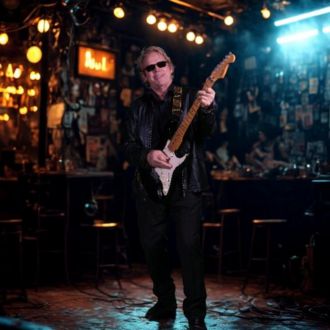 Described in variations as a rock, blues and roots artist, his album finds the enthusiastic musician/ engineer/ producer in spectacular and diverse voice, covering that ground across 12 tracks. There’s strong hints of The King (his mum’s favourite) on Shake For Me; gravel-voiced protest blues on My Freedom My Rights; and horn-laced singalong pub rock with Too Much White Too Much Red.
“This album is more rock, blues, really… and it’s groove. A bit more of my character and my feel is going to come out in this, how I naturally play. I have sort of a definite swing to my music, and I want that to come across.”
Never far from a guitar since he was 10, Pinny’s ‘comeback’ moment came in 2016 with the viral Facebook sensation O.B Can You Hear The Children Cry, a poignant guitar rock track with messaging about the suffering children across the globe face as a result of conflicts.
His 2018 EP ‘Twisted Minds’, which included O.B, along with the chugging rock ballad I Feel Like a Prisoner, and metal-edged Little Demons, with its strong anti-gun and anti-violence message, saw him badged a ‘social action rocker’.
A steady trickle of singles since has proven Pinny something of a musical chameleon, refusing to settle into one style, despite the considerable international success some of his tracks have enjoyed. I Feel Like a Prisoner returned as an aching solo acoustic lament during the 2020 Covid lockdown, and since then there’s been an assortment of soul, blues, rock’n’roll, pop and country rock. The US and Brazil have become his two biggest listener markets.
With Shake For Me and Hold Me Tell Me Love Me, the first two singles from ‘Hard Road’, the mood is upbeat, Pinny’s evidently having fun, exploring a natural sense of showmanship. He admits finding it hard to leave out his more country rock-oriented tracks, but a degree of consistency was the goal.
“I have been quite fussy about the album, this is a lot about my personality and how I’m feeling about things. And I wanted all the songs to be related to a period of time, you know, and that period has been the last two or three years.”
His recording studio is a large open upstairs space at the rear of the Turner Centre performing arts venue, close to central Kerikeri, where he’s been working since 2014. Initially he was engaged to help get the venue’s audio system working properly, but once the technician work became a near full-time role he asked to use the vacant storage room, and moved his home studio set up into it.
It’s about as unpretentious as a semi-professional working studio can be. The dividing walls are heavy theatre curtains hung from portable scaffolding, his Avid C24 recording desk and processor racks compact, walls bare, chairs mis-matched, and very few instruments or surplus equipment in evidence.
Guitars are mostly tracked straight into the desk, and when there’s a bass amp involved it gets put in the hallway outside. Pinny explains that a lot of his stage gear, including backline, PA and lighting is regularly used elsewhere as hire stock, and the studio is a fluid space, also used for theatre productions and recording other local artists.
Following that motorbike crash the would-be musician needed first to apply himself to getting his Waikato farm back up and running. He later sold it to buy more affordable land near Dargaville.
“I struggled, you know, really struggled financially. It was a real battle for a long period. I couldn’t do any of those things, so people were having to do them for me.”
Quietly driven in all his endeavours, Pinny was a good enough farmer and businessman that over time he became one of Northland’s largest dairy farm owners, employing 65 staff at the peak of his farming days. Convinced by family to buy a coastal property near Kerikeri they fell in love with the area, and these days he lives on a lifestyle block near the small township. Aside from family, music is his life.
“I don’t have any farms anymore. Nothing. Sold them all. I don’t miss them,” he smiles.
While farming in Dargaville Pinny started on a programme of audio engineering studies that included ProTools recording at MAINZ, followed by electronic music production studies at SAE in Auckland. With those recording skills mastered he decided he needed to learn how to make videos, taking himself off to the Australian film school in Sydney to complete a media composer and editing course.
“I went back to do that training because I wanted to be able to have full control over my recording. I wanted to be able to do it properly, and I saw that as being more sustainable. Because, you know, money was an issue. I needed that training so that I could achieve that.”
Luck of the good kind visited him when he visited friends in Perth, and while there contacted a recording studio to ask about finishing up this song he had part recorded. The producer he met with was Lee Buddle, who has since done all his mixing, and increasingly looks after final mastering as well. Pinny mentions Kelly Clarkson and Justin Bieber as two of his other clients.
Reputed Aussie session drummer Ric Eastman was also in the studio, setting up for a drum miking clinic the following day. Hearing Pinny’s laptop demo Buddle suggested they use it for demonstration, and record live drums to replace the programmed ones. The song was O.B Can You Hear The Children Cry, and a decade on the three continue to have a strong working relationship.
Through the diversity of his previous singles Pinny knows plenty about the ebbs and flows of international fandom. He’s become an avid student of the metrics around his single releases, as well as the impact of various social media promotional methods. Video, in various formats, has proven his most effective tool. The 2016 music video for O.B had over 10M views in a matter of weeks, with thousands of comments. He describes that as a happy accident, because he really didn’t know how Facebook worked then, he had inadvertently fluked it. Proceeds from the single were donated to World Vision’s Children in Crisis charity.
In contrast, following up his 2019 3-track EP Twisted Minds which verged on metal, with the country rock feel of Amazing saw him losing 50,000 Facebook followers in a week. “It was just like, booff they were gone, you know?” he laughs.
Now in his mid-60s, Pinny is rewarding himself with this album release, but has also been proactive in recording and supporting local musicians. In 2023 he established a programme called The Local Launch Pad, taking advantage of Ministry of Culture & Heritage recovery funding made available post-Covid.
“We wanted to try and do this project for the Far North, because we’re quite isolated up here, and because I know how difficult it is. Launch Pad was an initiative we set up for connecting local artists and helping them to find their audience. So we went to Dargaville, Hokianga, Kaitaia, Russell… and we just had meetings and joined the people up, so that they could talk together. And what actually happened was they started collaborating with each other on their own, so it was more about just having a connection.
“For me it opened up a whole lot of things that I didn’t understand about Northland music. I thought they were going to want a platform to release music onto, you know, like a Spotify type of thing. That’s not what they wanted at all, they actually wanted to play live and do that side of things. Some of the challenges they face are also quite different.
“We held some workshops, teaching about setting up a PA, learning what soundchecks are like, and the different elements of performing. Making a production video so that they could give something to a promoter, and just understanding those things.”
Launch Pad has led on to three shows at the Turner Centre and a number of participants setting up their own small projects, local festivals and the like. With the funding completed his own MMusic business has been covering related costs since. Pinny stipulates that for any live events the artists have got to perform their own original music, no covers, because that, as he says, is the whole point.
He smiles with a shrug of his shoulders when asked if making music has made him money – ‘not really’ is the inference. No matter, music clearly makes him happy, he believes in its power and it keeps him plenty busy. ‘Hard Road’ is not the end of his recording career, more just an overdue summary of where he’s at.