X-Factory: Reb Fountain – Come Down
X-Factory: Reb Fountain – Come Down
Reb Fountain has enjoyed a number of critical and commercial successes since the release of her debut album ‘Like Water’ in 2008. After three albums and a live EP, her biggest breakthrough came with the release of her 2020 self-titled album ‘Reb Fountain’, which garnered nominations for the Silver Scroll award and a number of Aotearoa Music Awards before winning the Taite Music Prize in 2021.
Her latest album ‘How Love Bends’ has met similar success, debuting at number 1 on the Aotearoa Albums Chart, while the lead single Come Down was a finalist for Single of the Year at last year’s Aotearoa Music Awards. The album also put her among the finalists for the 2026 Taite Music Prize.
‘How Love Bends’ is an achingly beautiful album; raw and unfiltered with minimal production that perfectly complements the honesty of her songs, while shining the spotlight on her soulful, at times fragile, voice. Its charm lies in its raw edges and often unconventional approaches to rhythm and timbre, showing that Reb isn’t afraid to move beyond the conventions of commercial music.
Come Down is not the most experimental track on the album, but it does showcase Reb’s use of rhythm and rhyme to help the listener navigate their way through the song. The song follows a typical verse, pre-chorus, chorus, bridge structure, but the repeating eight bar harmonic loop and relatively consistent texture means the harmony and arrangement are not significant contributors to steering the song.
Instead its Reb’s varied approach to rhythm and rhyme that demarcate sections and provide a clear sense of overarching structure. The harmony kicks off with an implied Bm over the intro and short opening verse before settling into a repeating 8-bar loop of Bm – G – E – F#7, two bars per chord. This progression continues uninterrupted throughout the track, though the harmony is often more implied than explicitly stated.
The arrangement is similarly consistent. The drums consist of a repeating one-bar loop without fills or contrasting grooves, while the bass leans into a steady root note pattern. A soft organ is the only instrument that fully expresses the chords, while a muted guitar plays a rhythmic pattern on single chord tones during the chorus sections.
A range of synth pads and a recurring vocal gesture provide some lovely delicate shape as they weave in and out of the texture, though these entrances and exits do not always occur at sectional changes. Overall the arrangement is minimal, understated, and undoubtedly lovely, with Reb’s voice doing the majority of the heavy lifting in terms of shaping and guiding the song.
An overarching point to make about the vocal melody is that it is highly punctuated with very little use of melismas, instead each syllable is usually expressed with a single note. Even words with naturally unstressed syllables are sung in a stressed and rhythmic manner.
The short opening verse melody begins on a pick up of the previous bar and has a largely flat contour, gravitating around the tonic note. It is predominantly based on eighth notes with a brief melodic flourish at the end of the phrase (Fig. 1).
Fig. 1. Verse one melody
Note also the assonance rhyme, same vowel sound but with different consonants that come from different families – lights (fricative) / hype (plosive). The third phrase has no direct rhyme partner (though ‘downtown’ has an almost internal rhyme feel), so we have a rhyme scheme of A A followed by a quasi-internal rhyme.
The melody in the second verse starts after the double bar line instead of before it, and introduces more 16th note movement, including the driving repeated rhythm in bar four. Again the melody is largely conjunct but the introduction of new rhythmic material gives a clear sense of evolution and forward momentum (Fig. 2).
Fig. 2. Verse two melody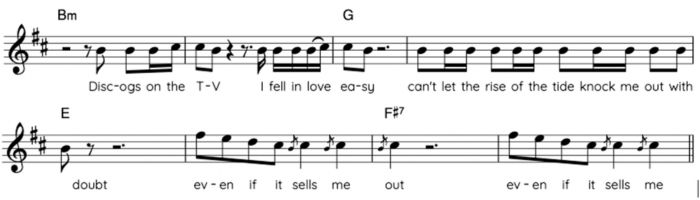
We also see greater emphasis on rhyme in this section, including assonance (discogs/love, rise/tide) family (tv/easy) and additive (out/doubt) rhymes. The rhyme scheme also evolves with greater use of holorhyme (discogs on the t.v., I fell in love easy) and internal rhyme (can’t let the rise of the tide knock me out with doubt). The accented quarter notes and repeated line at the end also calls for greater attention, as does the placement of the final word of the phrase occurring on the downbeat of verse three.
Verse three is also conjunct, but again introduces new rhythmic material, as well as a multi-rhyme (seventh and heaven/better than ever) before concluding with an open-ended family rhyme (hide/sight). Note that so far each verse has a distinct use of rhythm and rhyme which helps to demarcate the sections and move the song forward, even when the melodic register, harmony, and texture are largely consistent (Fig. 3).
Fig. 3. Verse three melody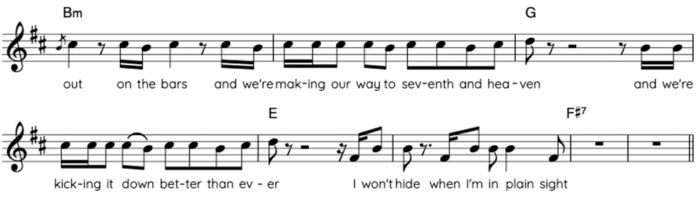
The pre-chorus introduces yet another, highly punctuated, rhythmic figure along with a rhyme scheme that leans heavily into internal rhyme. Also note the rhyming words, most of which are slant rhymes i.e. words that don’t exactly rhyme but sound close, especially if articulated a certain way. (For example the mosaic rhyme swipe left/right–eous). Again a repeated non-rhyme at the end of the phrase leaves it open ended, helping to drive the song forward (Fig. 4).
Fig. 4. Pre-chorus melody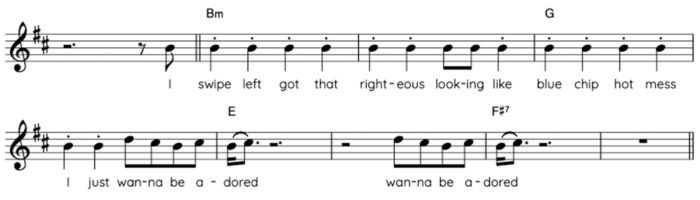
The chorus introduces yet another rhythmic figure, along with a type of call and response between the repeating hook and the answering phrase. The hook gives us the clearest melodic leap so far, while the answering phrase retains the now familiar flat contour.
It is the first instance in the song of a clear antecedent/consequent structure that creates a unique rhythmic grouping and highlights the section’s importance. Another key feature of the chorus is its exclusive use of perfect rhymes. While ride/high and ride/by are technically subtractive rhymes, listen to the way she leans into the vowels and almost avoids articulating the consonant all together, leaving us to latch onto the ‘i’ sound in each word. This is the first consistent use of perfect rhyme so far in the song, almost like she was holding back until the chorus to pull out the strongest rhyme type (Fig. 5).
Fig. 5. Chorus melody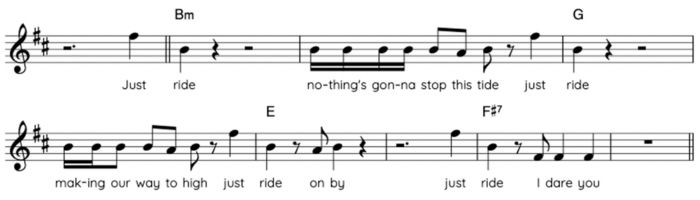
Like the previous sections, the bridge is also rhythmically unique in that it almost does away with a fixed meter and tempo entirely. While there are rhyming words in there, without a steady tempo and clear rhythmic placing of those rhyming words it lessens their impact. Reb’s vocals are delivered in a floating, free-flowing manner while the drums drop out, creating a momentary pause in the forward momentum before picking up a final rendition of the pre-chorus and chorus to close the song.
The vocal melody of each section has a different approach to rhythm and rhyme, and these subtle changes help make each section distinct and provide a clear sense of forward momentum. Rather than relying on a contrasting harmonic progression, dramatic changes in texture, or changes in vocal register to shape the song, Reb takes a far more subtle approach.
It’s a testament to the restrained approach that is found across the whole album, leaning into minimal understatement instead of throwing everything at it, and exemplifies the less is more approach to creativity.
Jeff Wragg composes popular and classical music, and also composes for film, television and theatre. He teaches classes in songwriting, audio production, and music production at SAE. Jeff can be contacted at www.jeffwragg.com