Matt Sephton: Samoan Sonic Explorations
Matt Sephton: Samoan Sonic Explorations
Owner/operator of a small recording studio in Coromandel township, Matt Sephton is a diversely talented audio professional; music producer, DJ, live sound engineer and more. As a sound artist his own work typically blends organic rhythms of the natural world with the textures of tactile bass music.
“Using found sounds, field recordings and playful sonic exploration, I create immersive soundscapes that connect listeners to both the primal forces of nature and the physicality of sound.”
In 2025, Matt and his wife, ceramic artist Caitlin Moloney, undertook a Samoan artist residency in the hills above Apia, with the shared intent to immerse themselves in a different culture and see how being in a new environment might transform their work.
For 44-year old Matt the experience was indeed transformational, resulting in the March 2026 release of ‘Vā’, an 11-track album album that merges field recordings, found sounds, explorations with hydrophones, collaborations with people and the land, and his signature bass heavy electronic production.
“This new project feels more personal, and not tied to any one genre, which is why it feels so exciting to be going in this new direction. Finding something that is purely my own.”
Has the Coromandel Peninsula always been home?
Mostly, I grew up here and have always felt at home across the whole peninsula – not just Coromandel town. I spent a number of years in my early 20s in Wellington, Wanaka and Christchurch, before finding my way back home where I now have a house with my wife Caitlin.
When did music become important to you?
I have always loved music, but was never very musical! I first heard DnB in my teenage years, listening to Concord Dawn on bFM. The raw energy and looseness of it appealed to me, just wild wonky music that seemed to have very few boundaries.
Then in Wanaka, in the early 2000s, my buddy Zane and I found our way into a radio station where we learnt (terribly) how to mix records. They had a massive stack of incredible dance records, so it was a dream to go in there and play that music. Then we both kind of got better at mixing, and eventually decided to study electronic production at MAINZ.
At what point did music become your profession?
After finishing study and coming back to Coromandel I became involved in community events, helping out with live sound for small events around town. As I got better skilled and gathered more equipment – speakers, microphones etc. – slowly the basis of a small business doing sound around the Peninsula developed. I was asked to help out with a couple of bigger festivals, looking back now it was a super simple role, but at the time it was a massive!
Over the past 10 years I’ve been involved with bigger festivals like Splore and Shipwrecked, working with the Lucky Star crew with their incredible stage and team. I feel that I’ve been doing my best work in these last 10 years, it sort of keeps building!
I am still Djing as Matt Rapid and manage to get booked for some midnight sets to play heavy and thick bass music, which I absolutely love. As well as the live work I also have my studio in Coromandel town where I enjoy recording local musicians, mixing other people’s projects, and creating weird electronic music.
When did you first open your Coromandel studio, and what sort of work has come through it?
I’ve had my little studio, Coro Sonic Lab at our home here in Coromandel since 2020. My business is mobile though, most of my recording projects are ‘on location’. I love that, setting up in temporary spaces for a recording project.
As well as my own music, I have a few clients that send me their albums to mix, although most of what I do here is local musicians from around the Peninsula. I’ve also received a few grants for community music recording and production projects. For instance, in 2023 I was selected as one of 10 artists from around the Waikato to be a Community Artist in Residence as part of the Whiria Te Tangata Programme, run by Creative Waikato.
Is live sound engineering part and parcel, or a different aspect and income stream?
Over summer live sound is my main source of income. A combination of local gigs around Coromandel with a few bands I work with, and simple sound system hires for events, and then a few bigger festivals further afield, where I will be helping to run a stage and also DJing late night bass music!
I’m away most weekends over summer, then in winter it’s the complete opposite – cold wet days here at home working on mixing and recording projects, either my own or for other people. I really love the seasonality of it, the fast pace over summer and then the massive slow down in winter.
Most of my income does come from those various audio roles, but I also work part time as IT support for a local community support organisation, Coromandel Independent Living Trust. We provide a range of services aimed at addressing rural isolation. It’s a great team with a really strong kaupapa.
 How did you come to spend time recording in Samoa?
Back in 2023 we were on holiday in Samoa, and came across the Tiapapata Art Centre. It was just such a lush, beautiful space, up in the hills above Apia, away from the resorts on the coast. We loved it straight away and decided we’d make it our mission to come back as artists. So we applied and were accepted to come for 10 weeks in 2025. It was actually a really easy process and the hosts are so welcoming.
So we travelled there in April, got settled into our little self-contained accommodation and got to work! Tiapapata is a bit of a hub, not just for artists but academics, cultural leaders, diplomats, students… There’s a café, gallery space, dojo, visitor accommodation as well as the studios. So there are a lot of really interesting people around.
We were there for two and a half months, from April to June 2025. It was the first time either of us had spent extended time in the Pacific, and it changed everything about how I approach music making.
Did you find the locals supportive and encouraging of your audio recording project?
Enormously so. The warmth and generosity we encountered – from the team at Tiapapata, the musicians and artists we met, from families in the villages – was humbling. People were genuinely curious about what we were doing and open to being part of it.
We found this so refreshing. Just being able to have all these great conversations with so many people, not having to prove ourselves or anything like that. We found people really open and willing to share stories, knowledge and time.
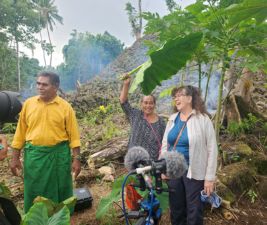
Tau’ili’ili Alpha Maiava, who performs fagufagu on the album, brought deep cultural knowledge and a real excitement about connecting traditional practice with contemporary sound. A family in the village of Sa’anapu welcomed us in and contributed umu sounds and spoken word.
And the music will be going back there too! We have a show planned at Tiapapata Art Centre in May, which feels like a beautiful full circle moment. It feels important to go back and present the music, to share and celebrate it with everyone who was involved.
What does vā mean?
Vā is a Samoan and broader Polynesian concept describing relational space, the active, living connection between people, between people and land, between the present and the ancestral. I found it embedded in the texture of daily life in Samoa, in the way people relate to each other, to the land, to the ocean.
It became the lens through which the whole project took shape. The music lives in that space too; in the field recordings and the electronic production, in the collaboration between artists, in the gap between what you hear and what you feel.
How does your audio work tie in with Caitlin’s art, if at all?
 At home we each have our studios and sort of disappear into our own worlds each day. With this residency we wanted to explore how our work can merge somehow, and we really didn’t know how that would look
Generally in Samoa we worked separately, in completely different mediums – Caitlin with clay, me with microphones and hydrophones – but in close proximity, getting inspiration and ideas from the same experiences, our conversations seeding ideas in each other’s work.
So in this way the connection was less about direct collaboration and more about shared immersion. But we are always discussing how our work can more literally be combined – audio and ceramics – and we have some ideas for this which we are working on. The hydrophone seems like the best way to merge our practice, capturing the sounds in water within a ceramic vessel is definitely something to explore further.
One track on ‘Vā’ makes the connection explicit. Clay was created from the sound of clay dissolving in water, a collapse of form captured beneath the surface at the moment it gave way. It felt like the place where our two practices met; material becoming sound, form becoming formlessness.
Was recording an album the goal on departure or realised as an option whilst there?
I didn’t think at all that I’d be making an album! The purpose was really to simply break free of our habits and see what happens. My intention was always to make music, but I had no fixed idea of what form it would take, I just wanted to record some cool sounds and was open to any possibility.
I specifically avoided letting myself build any expectations prior to departure, but pretty soon I realised that a cohesive collection was emerging. I’d never been so prolific, new tracks were coming together so quickly. After a month I knew I was making an album and then sharpened my focus with that aim in mind. The title came later, but the concept of vā – the relational space between things – had been present in the work all along. I just needed the word for it!
How many hours of field recordings were involved? What were the building blocks to some of the tracks?
How many hours? Haha honestly I couldn’t tell you, and in some ways the number doesn’t matter. Many of the recordings I never listened back to and probably never will. I know this might seem strange, but a large part of the process is simply going somewhere and intentionally listening. Recording yes, but the recording is sort of secondary to the initial act of being present.
One day I simply sat on the end of a jetty with the hydrophone sunk into the water and listened to these tiny sounds of the underwater, the most beautiful sounds. It’s like meditation in a way, the only thing that exists in that moment is the sounds.
To begin building a track I’d have a listen back to what I had, quickly previewing a bunch of poorly named wav files, letting my mind wander, seeing what ideas came up, if any came at all. Sometimes nothing does and I move on. But if I found a cool moment I’d drop it into Ableton and mess about with pitch and effects, or pull it into Pro Tools and start layering other sounds around it.
A randomly cool rhythm might emerge from the pops of raindrops, or maybe a distant background sound is more interesting than the foreground. I’d start pulling elements out, focusing in and follow whichever direction shows itself.
For Horizon, I’d already mostly finished the track and was happy with it before meeting with Tau’ili’ili Alpha Maiava to record the fagufagu (Samoan nose flute). I’d used a lot of these lovely small watery sounds captured with the hydrophone; drops and bloops, a little delay and reverb, and they just sound so nice – and at the time the track had a much faster breakbeat mixed in.
We met up with Tau’ili’ili in his home on the north coast, sitting around his kitchen table, I loaded up Horizon and he played different tones on the fagufagu. The sounds fitted so perfectly, and so I heard this track – which was already feeling good – just become something else entirely.
I got rid of the faster beat and let the sounds breathe, letting it feel open and expansive. The rich and sort of primal fagufagu helping bind the electronic elements to something ancestral. The fagufagu is one of the oldest Samoan instruments and Tau’ili’ili is actively working to revive its practice – having that sound at the centre of the album’s key track felt important, it felt really special.
Paper opens with Awal Muhammed – a Ghanaian papermaker resident at Tiapapata’s workshop – describing his craft with real enthusiasm. We had a lot of fun recording in his studio. He understood the process immediately and was genuinely into finding the most interesting sounding paper.
In the final track his voice rides a bed of cinematic synths and the delicate crinkle of handmade paper over a simple rhythm we made together. I had made the first half initially, it was mostly finished but I felt it wasn’t really going anywhere. So I leaned into familiar ground and let it open into rolling drum and bass; his warm voice, a shuffling beat, a low old-school bassline. One of those collaborations that arrived unexpectedly and became one of the album’s most distinctive moments.
Umu closes the album with birdsong, children’s voices, and the sounds of hot koko being prepared from scratch on an open fire – gathered during a visit to a family in Sa’anapu. It’s the most unprocessed track on the record I think, the sounds being the closest to pure document. It felt right to end there – with people, with food, with the ordinary warmth of daily life in Samoa.
And how does the track building process evolve?
The process was never fixed, I’d start from scratch each time and build around whatever sounds were in front of me. I use both Pro Tools and Ableton Live, switching between the two to get the best of each. I love how audio samples can be manipulated so easily in Pro Tools, and I appreciate its more structured approach to the editor – you get a full view of the track, start to finish, which helps with shape and arrangement.
Ableton Live is the opposite; non-linear, flexible, more uncertain in a way that feels more human. So I’’d move between them depending on what the track needed, sometimes having both open and routing sounds between the two.
I also used a programme called Paul X Stretch, which lets you stretch sounds to something like 1000x their original length, turning a short recording into these incredible sprawling pad-like soundscapes. That became a key texture across the album. I love these ways to introduce randomness into the process.
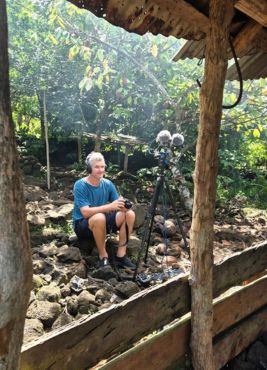
For recording my main hardware rig was a Zoom F6 recorder with a matched pair of Rode NT5 mics for stereo field recording, and an Austrian Audio large-diaphragm condenser for mono sources such a vocals, wooden drums, that kind of thing. The main focus being on clarity in the initial recording.
For walks and quick captures I’d grab my Roland R26 handheld, reliable, pocketable, no faffing about with stereo mic bars. Though on this trip I got a bit too close to a blowhole and I think it’s finally done for!
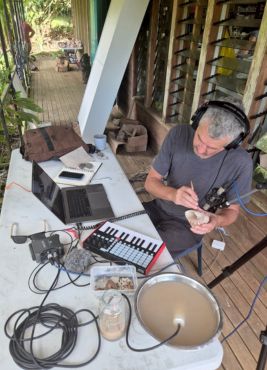
And then the hydrophone, which was my favourite thing by far. It captures underwater sound beautifully, crisp clicks and pops from a world you’d otherwise never hear. I actually built it myself from a kit I found online, sourcing the parts, piezo pickup, circuit board, resin, and putting it together out on the veranda in Samoa. I couldn’t afford a high-end model, so I made one! It’s become one of my most-used tools, and also something I’m working into the live performance of the album.
Some days I’d be purely focused on recording, heading out from the art centre or driving further into the island to find new sounds. Other days I’d stay in with headphones on, drinking coffee, building tracks in my own little world. I’d work quickly, sometimes sketching two or three in a day. Most got abandoned. But every now and then the sounds would just lock together into something perfect, and those were the ones that made the final album.
 What does ‘Vā’ encapsulate for you personally?
I’ve released music before as Matt Rapid, bass heavy electronic work. But this is the first piece of work I’ve made that feels completely like me – not a version of me, not a persona, but the actual thing. Going to Samoa with Caitlin, immersing in a place that wasn’t ours, listening carefully and making something from what we found there – that process changed how I think about what music can be, and what it’s for.
‘Vā’ encapsulates this shift; from making music about sound to making music about place, people and connection. And it’s the beginning of something that I am really intrigued by, I want to keep doing it this way. Removing genre expectations and simply following threads of ideas, wherever that thread leads.
What platforms is it on? What expectations do you have for the album?
‘Vā’ is available on all streaming platforms, I hope people go to Bandcamp though. Really, I am happy just to have this project alive in the world. I have no expectations for listeners or sales – although of course I hope people like it and listen!
What I want more than anything for this album to serve as a sort of pou, a totem, to build from. Caitlin and I want to do more residencies together, to see what we can make in different environments. The creative exercise is the aim.
What’s your next work project?
‘Vā’ is the first chapter in what I intend as an ongoing practice of place-based music-making, each project rooted in a specific location, made in genuine dialogue with its people and environment. We have some ideas about the next destination, but in the meantime I’m focused on the live shows – Coromandel, Auckland, Tauranga, and a return to Samoa in May – and on releasing a companion collection of some of the raw field recordings.
The field recordings stand on their own as a listening experience and I want people to hear the source material, and also to give these sounds a home that isn’t just my hard drive! This winter we’ll be staying home in Coromandel, so I will try and shift focus to this environment; hopefully take the same approach and make music based on the slowing down, the rain, the cold, the rawness of this place in winter.