Shaun Garea: Soundtracking Fantasy Board Games
Shaun Garea: Soundtracking Fantasy Board Games
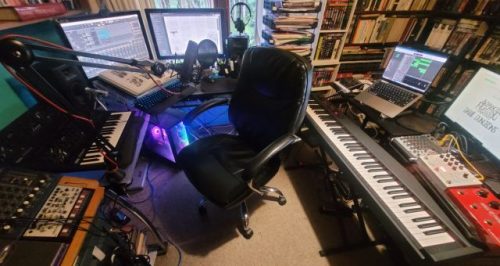
Shaun Garea was born in Cornwall, England some 40-odd years ago, moved to Aotearoa as a youngster and has since lived in Christchurch, Auckland and the Manawatū, where he has a small home studio. His musician aptitude is mainly synths and piano, but he also has experience as an indie filmmaker plus lots of other artistic, academic and professional skills.
Shaun recently completed composing a soundtrack to a new board game called Dark Dungeons, part of the Advanced Fighting Fantasy franchise. The game release has been delayed, but as a stopgap the soundtrack (see links below) has gone out to the gamers who helped crowdfund it. It’s his sophomore work in the board gaming arena, the first being a soundtrack album for Doom Pilgrim. Composing music for the in-game pleasure of dark fantasy board game players seemed so unlikely that NZM thought we should ask more about this musician’s work and motivations.
How far back does your music making stem from?
We were dirt poor as a child but I won a competition. I must have been 5 or 6, and it was for a Casio PT1 (which I still have lying around somewhere). That was definitely the start, I have vivid memories of those sounds and slowly picking up simple melodies through trial and error.
In my late teens I started getting into the local band scenes and from there into performing with different groups featuring people much more talented than me. I had a Tascam 4-track Portastudio during that time and loved laying tracks on that (mainly weird vocal stuff) too. I moved more into indie filmmaking in the 2000s, and from there the mechanics of digital recording and mixing. And once bitten by that bug…
Is filmmaker the profession you write on travel docs?
Ha, no. My bread and butter is actually in lecturing. I teach in psychology, and I research psychology and gaming as my main job. But I always like to ensure that I have creative outlets and projects on the go, otherwise I think my brain (and soul) would shrivel up!
I have done a few music videos and the like, but I generally do them for artists I really enjoy, and there has to be a reason to do one. So when I do get inspired, I am all-in. As an example I did a music video for Jordan Reyne (super cool Kiwi artist based in Europe), taking a very fun low-fi approach, like a theatre production. I think Jordan is a heavily under-rated talent.
Can you introduce us to Estrata Productions and what it does?
Originally it was an umbrella way to book national tours for a bunch of strange bands and performers in the 2000s. Over the years though Estrata sort of just turned into things I am doing across mediums (be it film, music, comics, or writing). I have built up a pretty good group of friends and collaborators over the years and it’s also just a nice lifeline for me. Whilst work and life make their demands, I still have Estrata as a reminder that ‘normal life’ hasn’t completely swallowed me yet.
How did you come to compose a soundtrack album for Doom Pilgrim?
Well around the time Christchurch artist Ange.Mac and I made an EP (find it on our Bandcamp), which was a hybrid collection of moody tracks. Anyway, we found some interesting art for the cover and paid the licence for that. Then we saw that that same artist was actually designing a game, and thought, ‘Hey we enjoyed making the EP, maybe we could tackle a soundtrack for this designer?’
We contacted the designer/artist, worked out a plan, and put together the project which turned out to be Doom Pilgrim. This was on a shoestring, so I drew up a little mechanical licence exchanging some art for use of the music and tada! Ange composed/recorded half the tracks, I did the other.
In the case of a board game soundtrack, how does that then get marketed and noticed?
With music for boardgames it’s sort of a blank canvas at the moment as it’s a new-ish avenue for music. Doom Pilgrim for instance was crowdfunded through GameCrafter, and Dark Dungeons (this new album) was crowdfunded through successful campaigns on both Kickstarter and Gamefound.
What this means is that when these campaigns fund, the games themselves have already found their market before production starts. Then when soundtracks are given away with any game pledge on such platforms your soundtrack automatically goes to each backer. The bigger the campaign, the bigger the immediate audience. Beyond that, I’d say a musician would need to self-promote to get a bit more attention. (Depending on the contract/licensing it may or may not be worth their time to do so though.)
What’s an estimate of the playing audience size, for Doom Pilgrim say?
I wouldn’t be able to even hazard a guess at this stage. We distribute the album on Bandcamp, but so does the game creator, and this was given out to all folks who bought or backed the game when it was originally crowdfunded. For Dark Dungeons for instance that’s over 1000 copies of the album that goes out to backers as soon as the campaign successfully ends, then it’s available for purchase separately. People can buy Dark Dungeons here
 Is there any financial return likely?
For Doom Pilgrim, no. We give that away essentially as ‘pay what you want’ on Bandcamp ourselves. Look, some folks drop a donation which is nice, but we aren’t going on holidays with that goodwill. I will say though that that project was never made to ‘make money’. We went into that with the idea just to get our hands dirty with a game soundtrack and get it released. (Could we do it? Yes we could!)
Personally, I was working with lots of compositions and tracks and really wanted an outlet for them. So having a theme, focus, and deadline is a great way to channel those ideas and impulses into a final product. With contracted works though, there is the payment for the job, then percentages of sales ongoing so it isn’t just all heart and hope.
What sort of listener feedback do you get, if any?
It’s often very positive. People enjoying certain tracks and the overall feel of the albums. I get a lot of gamers saying they enjoy the music for their D&D games, and hey I understand that for sure!
I will say the surprise (that the music sounded good and/or polished) in some people’s communications is nice, I take that as a compliment. I guess the expectation for some folk is that, ‘Hey this is a free album with a game, it can’t be good,’ right?
With Dark Dungeons were you commissioned for the soundtrack?
Yes, this was a commissioned work. As I mentioned before, a key driver for me is to find goals to work to – be that a publishing date or event, or deadline for a contract. This allows me to mentally ensure that I make the time for projects and it provides a framework or lens through which to filter my ideas.
The funds allow me to both understand how much work should go into this (I mean is this a few weeks or a few months work?), and then actually set that time aside. But that’s the goal. With Doom Pilgrim it was to get the ball rolling, get a taste of soundtrack work, then Dark Dungeons was picking a contracted job in the space (particularly with a known IP), and then who knows what’s next?
How long did you spend soundtracking Dark Dungeons?
I took a month off work last year (2025) in January and recorded the bulk of the soundtrack then. I like to try and hyperfocus on a project, so essentially taking a month off my day-to-day work allowed me to treat this as its own thing. It also gave me a deadline which is always helpful for me.
I think the hardest part was just figuring out the big picture. The album has two key types of tracks; heroic fantasy themes (these are shorter), and dark ambient tracks (usually quite long) but it took me a little while to get my head around how the album flowed.
Anyway, after January was over, I emerged from my recording-cave with minimal work left to do beyond just dropping in an extra layer of goblin sounds for the goblin march track when I felt like it.
Did you compose from research, or more simply from your game player/musician’s gut impression of the game environment?
A bit of both, I haven’t really analysed my approach so much as I just fall into it. With Dark Dungeons yes, I listened to reference music from the periods and tones that I thought would be helpful (Basil Poledouris, Beyond the Ghost to name two for instance). And I also had a lot of art out in my studio space from the old Fighting Fantasy games (art from folks like John Blanche, Russ Nicolsen, Ian Miller etc. – 80’s fantasy stuff).
Then though, at some point it’s just you at a keyboard trying things for hours on end. “Do I like that?” “Maybe if I went here instead of there?” “Okay, I’ll put a pin on that because I have an idea for something else”.
But with boardgame scores you aren’t tracking to action on a screen, it’s more about setting a tone and creating a vibe for a session. It’s actually a lovely way to compose, to think of players immersing themselves in their games. But yes, when the fog cleared and I had the album, I can definitely trace that progress to some of that research and reference work.
What sort of shadow does Ai cast over the future?
So, in my teaching work the question we have to ask is, ‘Do students actually know the things that their work suggests they know?’ Because with Ai it can sort of be like using a calculator before you have drilled your timetables right? Correct answers but without real understanding. In education, you know we need to certify if someone knows something, and we measure that by what they submit (hence the drama now).
With art though, ‘showing ones working’ or demonstrating understanding is less of a focus because it’s not process based, it’s more outcome based perhaps?
I just think that with Ai now, this is helping us perhaps reconsider that focus on outcome only, and encourages us to move it to what drives an artist to make the choices that they do, what was their background? Just moving that human element higher on the totem pole a little bit more.
What shadow Ai casts is frankly at times somewhat demotivating personally – seeing comic art done in seconds and remembering how long it takes me, not just to pencil and ink, but colour a single page. I remember it resulted in me being less enthusiastic about going back (literally) to the drawing board.
So, I think we will need and likely will see a renewed focus on artists and process as people look for that connection they used to get by default from music. (But now knowing that some music may be Ai, they begin looking for the roots of that music and the artists a bit more). Things like NZM, still here, still covering local music, this stuff (I hope) may see a resurgence in presence. If so, that would make me very happy indeed.
Do you have film score or other aspirations?
Absolutely, I would love to do more and more and more of this work. Pairing music with film or gaming, helping create that immersion is a joy. I am super humbled to have the opportunities that I do, so I try to deliver on time with no fuss and I feel that my work ethic definitely helps.
There’s nothing quite like finishing a track that didn’t exist a few hours earlier and just feeling that rush of accomplishment at hearing your creation, right? An example; the last track on Dark Dungeons was just me playing around live with some strings and I think 30 minutes later I had something that flowed well and resolved (I think) beautifully. It put a little full-stop on the project and allowed this mental image of adventurers now riding off into the sunset. So, the opportunity to do more of that? Yes please!
A big part of the game soundtrack approach for me is just trying to find a new avenue for making music, a new space where you can get contracts and jobs and build your own skills and releases. I think this is one of them and I am doing pretty okay thus far. Oh, and I also have dozens of tracks that one day I will polish up into an album called ‘Themes from Films that Never Were’, but that is a no-deadline project, so who knows when that will ever get released!
Shaun Garea soundtrack sampler:
Doom Pilgrim – Pilgrimage
https://angemacplusshaungarea.bandcamp.com/track/pilgrimage
Hopeful and adventurous, versions of this theme bookended the Doom Pilgrim album and provided some respite for the darker tracks contained therein. I liked the journeying nature of this, the rolling waves and seas, storms, the forest at night…
Dark Dungeons – Hunting the Dark Coven
https://shaungarea.bandcamp.
This has somewhat of gothic and Silent Hill (Yamaoka) vibe at times, with a slowly building piano over chants and synth. Setting the scene for adventurers getting into deeper trouble.
Dark Dungeons – The Fighting Fantasy
https://shaungarea.bandcamp.
A short but rather bombastic ’80s fantasy theme reminiscent of sword and sorcery films from the period that Fighting Fantasy first launched. All brass and strings, drums and chants.