Richard Langston talks about The Clean: In The Dreamlife You Need A Rubber Soul
Richard Langston talks about The Clean: In The Dreamlife You Need A Rubber Soul
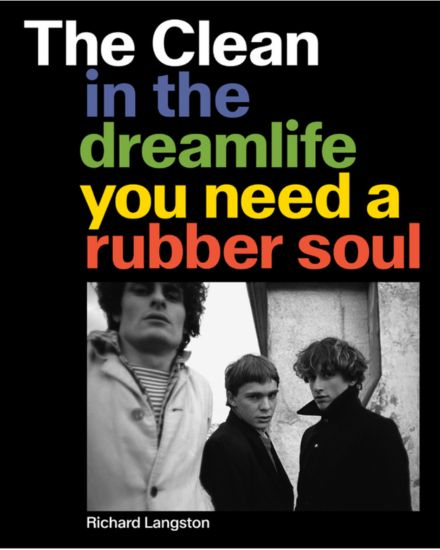
Richard Langston, author of the richly insightful oral history of The Clean published in April 2026 by Auckland University Press, has his own storied history in and around the melee of NZ alternative pop music. Raised in Dunedin he has written about that city’s music scene since the 1980s, including as editor of the fanzine Garage from 1984 – 86. Langston’s creative contribution to the Aotearoa art landscape has also included poetry, journalism and as a director of Kiwi television gem Country Calendar. Dave White, leader of Wellington-based punk noise trio Lung, asked him some questions about The Clean: In the Dreamlife You Need a Rubber Soul.
 In spite of my primal love for more hardcore NZ guitar sounds like The Gordons, my exposure to The Clean and their pop happiness resulted in instant pleasure. I loved the loud loose guitar sounds, simple but driving rhythm section and out-there vocals. I still have their original Tally Ho Flying Nun released 7″, and still remember their awesome set at the venue I was managing in Nelson, The Artery, in February 1999.
In compiling The Clean: In the Dreamlife You Need a Rubber Soul, Richard Langston has done an exceptional job. The book records their oral history complete with amazing photographs of this seminal NZ band in their own words, in a style that accurately represents their astounding and enduring international impact.
Why choose ‘In the Dreamlife You Need a Rubber Soul’ as your title? Is it part of the Clean culture of trying to be understated and a little obscure rather than obvious, like Tally Ho for example? Do you think the title is a cunning reference to Chris Knox’s jandals?
Ha ha, I never thought of the link to Chris Knox’s jandals but I like it. Chris did so many miles in his jandals delivering records for Flying Nun in Auckland they might be closer to weary soles than rubber soles.
We all loved the song (Dreamlife) and no-one in the group wanted an obvious title like Tally Ho or Anything Could Happen. In fact, they gave the latter song title to Grant Robertson for his political memoir, so it could not be used by our book’s publisher. The Dreamlife title hinted at the fact there was a lot more to the band than those obvious known songs – there’s five albums worth that people might not have been that familiar with. The title was a nod in the direction of their whole catalogue and that there were songs to be discovered beyond the popular ones.
It also alludes to the fact that the dreamlife as a musician may be a lot more difficult than you think – a lack of money, and butting your head against the prevailing conformity. The Clean experienced plenty of that especially in their early days when they were not liked – often hated – in Dunedin. They were dismissed by industry and radio station people and derided by musos – the sort of ‘musicians’ who played covers in Dunedin pubs at the time.
The Clean have always been upfront about influences and being inspired by riffs from other bands like the Rolling Stones to create new material. In your research which influence was the most unexpected?
I hadn’t realised how much they liked The Doors, and that influenced The Clean in their use of keyboards. I knew David Kilgour liked The Door’s guitarist Robbie Kreiger but I hadn’t appreciated how much of a fan he was of Ray Manzerak and the keys contribution to the sound of The Doors. Mind you, The Doors were influenced by The Seeds and plenty of people in the Dunedin music scene loved The Seeds. I love them too. Can’t Seem to Make you Mine is one of the great songs.
You’ve done an awesome job of collating an oral history from multiple sources and there’s a lot of love expressed throughout. Did you come up against any disagreement over any particular stories, in particular the memories of Hamish vs David, or did the bulk of retrieved archival material clear up any discrepancy?
The Clean kept a diary in their early years and that was invaluable in sorting out the story, and so were the letters that Hamish and David wrote to each other and to their friends and confidants. The funny thing is the Kilgours hardly ever dated a letter but I could work out when they were written from other clues such as gigs they mentioned or songs they were about to record or other events they mentioned that I could date check.
Those diaries and letters lifted the book to a whole different level – personal and intimate. I couldn’t believe how many documents they had kept and what an archive they had. David Kilgour kept finding letters right up until the book was due to go to print. He found Hamish’s 1977 diary three weeks before my deadline. It was amazing to read those entries about his going to see a Lou Reed concert in Dunedin, and his visiting Roy Colbert’s record shop and what records he was buying and selling that year.
What is your fave live gig story? I love the Logan Park High School saga, our band had a similar experience at Palmy North Girls College early on, it was like being The Beatles!
Fortunately a lot of live performances by The Clean were taped by sound people and fans. Their six minute debut in 1978 was amazing to hear 45 years after the event. It put me right there in the hall. I didn’t have to imagine or embellish the performance, I was hearing it as raw and rough as it was.
Then I heard the live recording of the Logan Park gig which was less than a year later. I was astonished at the development of the band. They’d written their early great songs by then including Anything Could Happen and Point That Thing. The recordings were a real spur to telling their story, they kept me excited – I couldn’t believe how good they had become in such a short space of time.
But my favourite live gig story is the one when they played their cousin’s 21st in the community hall in Parnassus, North Canterbury in 1982. This was an audience of largely country people and family and The Clean played as loud as ever while plates of sausage rolls were served and the older members of the audience were driven to the back of the hall by the onslaught of sound. There’s a magic to that, and David Kilgour’s description in the book of driving back to their childhood farm after the gig.
Some of the photos are truly amazing. How did the 9/11 Twin Towers pic come about?
Robert Scott took that photo. The three of them had climbed onto the roof of where Hamish was living in New York with his wife, Lisa. Robert took lots of shots of the band but that was his prize one. I think it was taken between the collapse of the first and second towers. That’s a moment.
Robert only found the photo close to deadline; it nearly didn’t make the book. They all describe that crazy time with insight, the impact it had on them. They did themselves proud by playing a gig a few days later which was reviewed in the New York Times as the sort of tonic the city needed.
I was a uni student in Christchurch 1977-81 & the Gladstone was our place. How would you describe the influence Jim Wilson and his door girls Laura Hart & Rose Stapleton had on establishing the band there?
Jim Wilson and Laura Hart and Rose Stapleton gave The Clean the break they needed and deserved. Jim went down to Dunedin to hear The Clean in their practice room and after a few songs he knew they had the goods. Jim said: ‘The love went around the room’ or words to that effect. This was at a time when they were not loved in Dunedin.
The Clean established their reputation at The Gladstone in 1981. Every time I saw then that year they were on fire, just knock-out stuff. I thought then they should been known around the world. I travelled overseas in 1982 with cassettes of their first two EPs and ‘Tally Ho’ and played them to whoever would listen. I helped get two tracks of theirs on an Australian compilation issued by a London label in 1983.
The Thistle Hall gig in Wellington when the King Cobras caused shit, was that just bad timing, bad luck or was something more sinister happening in the underground music scene?
There was violence in the music scene – caused by different factions – punks v boots boys or whatever. Punks were always a target. Anyone who was punk in the Dunedin scene or in a band perceived as punk or different would be targeted by V8 boys. Shayne Carter, Graeme Downes and Martin Phillipps all had stories of the violence – and the constant threat of it.
I lived in London on and off for 18 months in the early to mid-‘80s and never saw any violence. I came home to Dunedin and saw someone getting their head kicked while on the ground outside the Captain Cook Tavern after a gig. NZ was a violent place in the 1980s especially if you dressed in a manner or played music that suggested you were not conforming. I think that outbreak of violence at the Thistle Hall was symptomatic of that.
Garage was a great zine – Bryon Coley of Forced Exposure stated it was the only useful source of info in those difficult snail-mail years. Any particular reason why you stopped?
I started Garage purely as a result of the music I was hearing in Dunedin in the mid-‘80s, and I had read ‘zines when I was in London and thought they were such an effective way of conveying news and obsessions you wanted to share. There were not that many forums where you could write about the music that was inspiring you.
The ‘zine was a low cost way of spreading the message to a much wider audience – and as it turns out to an international audience. It sold in London and New York and Sydney and in faraway places we’d never heard of. I didn’t know that would happen when I started it. I thought we’d have some fun and stop after a few issues.
We went for six and got much better at recording and writing about what was important to us and other music nerds and fans. It went six issues and I had actually started a seventh when I did an interview with Peter Jefferies. I wanted to put him on the cover. But life took over and I needed to earn some money and I never managed to get another issue out. The Clean book is a resumption of my particular obsession, so it could be seen as Garage 7 – in a certain way. It just happens to be way more professional in every element. Auckland University Press put so much love into the book I’ll be forever grateful.
Would you consider restarting Garage?
No, I think there are more effective ways to do justice to the music I love. I’ve started writing an oral history of The Chills and in a way I could think of that as Garage 8. It will just be a lot more professional looking as again Auckland University Press is the publisher. They’re a great press committed to recording a vital part of our music history in a cool way. i.e. ‘Write the book Richard, and as long as you’re not too nutty we’ll publish it.’
My original Flying Nun 7″ of Tally Ho is now unplayable, but I have the Merge reissue. Such a cheeky song. How the hell did they get this first release from an unknown record label into the NZ charts?
Tally Ho got into the charts because the music industry had been changed by punk. The industry’s major labels no longer had the control it had exerted for decades. Indie labels sprung up in the UK and USA, Australia and NZ and they changed the music scene – the fans who bought those records were now setting the agenda. Tally Ho got into the charts because it was the sound of a new generation of music fans. It was what they wanted. It was a joyful noisy garage pop song – the sound of non-conformity, of ‘this is us and we’ll do it our way’. That generation in repressed Muldoon-era NZ responded to it.
The Clean played my venue The Artery in Nelson 27 Feb 1999, a truly inspiring night. The only mention in the book is an offhand comment by Bob Scott saying he was dubious their $600 Holden ute would even make it to the first gig in Nelson. Did you consider including a timeline of their live gigs?
An oral history is a different beast from writing a detailed biography of a band. That’s why I never considered listing gigs or all their records with catalogue numbers. An oral history is driven by story not discographies and the like. You can find them on the web if you need to know that stuff. I’m interested in the human story – the memories of the band and their close circle and eye witness accounts. Give me story or great details. I was so grateful I encountered many great story tellers for the book.
I love the way you haven’t glossed over any of the at times difficult episodes in the band’s journey, but have efficiently facilitated the conversation throughout. How you feel about the work and its reception at this point in time, is there anything you’d like to change or add?
We’re all stoked the book has been received so well. We did a series of book launches in Dunedin, Christchurch, Wellington and Auckland and musicians turned out to play songs by The Clean. They were all fabulous events, and the generosity of those musicians and their admiration for The Clean was something to see and hear.
David Kilgour and Robert Scott played Clean songs with a young drummer Josh in Dunedin at the first book launch and it magic to hear those songs again. Talk about love going around the room, brother it was something. The hair on my arms stood up. They were so casually wonderful.
The book was also simultaneously published in the USA by Feralhouse.com and that shows the reach and popularity of The Clean. The first printing of the book sold out in the USA within a matter of weeks. The Clean’s US label Merge will reissue the band’s second EP ‘Great Sounds Great’ and the 45 Getting Older later this year, and that might ignite further interest in the book. It’s a great ride.