Observation Post: Framing Alien Weaponry & Kneecap
Observation Post: Framing Alien Weaponry & Kneecap
Some things stay: Yma O Hyd, Alien Weaponry and Kneecap – language, memory, and the sound of things refusing to disappear…
First crushes came in unlikely pairs. Anna Bergman and Francine Pascal – a bosomy Scandinavian and a permanently smoking Frenchwoman wrestling for my soul and assorted peccadilloes. The stain on the bedroom wallpaper lasted longer than either of them. At the time I was convinced I’d broken something fundamental. The joys of a young Catholic boy, promised to God and the Devil in equal measure.
Elsewhere, the lessons were less amusing. 1970s television did its best to fill in the gaps – the broad caricatures of Mind Your Language, the knowing smirks of Are You Being Served?, the eternal horrors of a young Jim Davidson – a world in which identity was something to be laughed at rather than understood. It took years to realise just how much of that I’d absorbed without thinking.
Which is why something likeYma O Hyd hits differently and always will. Nearly 40 years after Dafydd Iwan first sang it, Yma O Hyd doesn’t feel like a relic – it feels like a reminder. The language, the history, the refusal to disappear: all still there, still alive – and, in my case, permanently etched thanks to Tom at Roger’s Tattoo on Cuba Street, an early celebration of my return to Aotearoa.
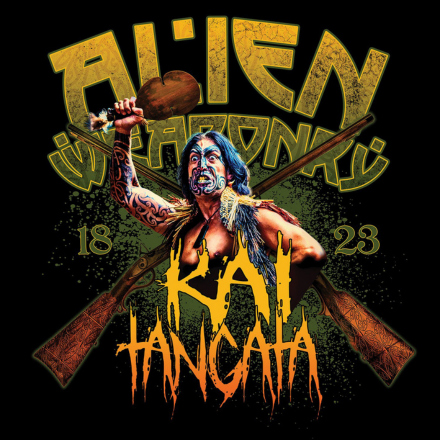 Half a world away from young Davey, Alien Weaponry are doing something strikingly similar. Different sound, different context – but the same underlying instinct: take what was nearly lost and give it weight again, give it presence.
And it’s not just happening here. Back in the land of my father’s fathers, Kneecap are doing something just as vital with the Irish language – dragging it out of classrooms and policy documents and dropping it squarely into clubs, into headphones, into the hands of people who might never otherwise have touched it. Different sound, same instinct: take something that was supposed to be fading and make it live.
Not everything old needs to be thrown out. Some things just needed a new voice – louder, prouder, and a little less interested in asking permission. What makes both Alien Weaponry and Kneecap compelling isn’t just the surface – the riffs, the beats, the volume – but the intent behind them.
Alien Weaponry’s sound is all forward momentum: tightly locked riffs, rhythm section sitting deep in the pocket – all thunderous drums and sinewy bass. Lewis and Henry de Jong keep everything grounded, never rushing, never spilling over. Tūranga Morgan-Edmonds running his bass like a taniwha incarnate – muscular, melodic and always just beneath the surface.
There’s a discipline here that mirrors the kaupapa – the sense that this isn’t just performance, but transmission. Te reo Māori doesn’t sit on top of the music, it’s embedded in it, carried by it. People of the land in every possible sense. Kneecap work differently, but arrive at something similar. The beats are lean, direct, built to move, but there’s an acid sharpness to the delivery.
Mo Chara and Móglaí Bap treat Irish as something elastic and alive, as much the language of rebellion as romance, while DJ Próvaí holds the centre. The humour is there, the irreverence too – but beneath it runs something harder to ignore – a tension that feels as much like a challenge as an invitation.. This isn’t just revival; it’s reclamation – and reclamation is rarely neutral.
Two Voices, One Argument
Call & Response I: Identity Held / Identity Declared
Kai Tangata
Alien Weaponry come in heavy and deliberate – the riff locked tight, the groove anchored deep, everything built for impact, that opening figure repeating like a warning you’re not meant to ignore. The use of te reo Māori isn’t decorative; it’s structural, woven into the weight of the track itself, its intricate warp and weft belying its sheer emotional power. This is identity as something held dear – grounded, inherited, carried forward with intent.
C.E.A.R.T.A.
Kneecap answer in a different register. The beat is lean, the delivery sharp, Irish flipping between humour and confrontation without warning, lines landing with the rhythm of a chant half a step ahead of the beat. Where Kai Tangata holds its ground, C.E.A.R.T.A. pushes outward – identity not just asserted, but tested, challenged, made public.
Different approaches, same core truth: language isn’t passive. It doesn’t sit still. It moves – the kind of energy that turns into something collective, something shouted back at the world rather than quietly accepted. Not here. Not now.
Call & Response II: Discipline / Disruption
Rū Ana Te Whenua
There’s a controlled intensity here – the rhythm section deep in the pocket, guitar work precise, everything moving as a single unit, the stop-start riffing snapping back into place with mechanical certainty. Even at full weight, nothing spills over. This is discipline as strength – knowing exactly how much force to apply, and when. Heard live, it’s seismic take my word for it.
Get Your Brits Out
Kneecap come back less contained, more volatile. The beat hits direct, the vocal delivery jagged, deliberately pushing at the edges, hooks landing like slogans you weren’t expecting to remember but do anyway. The humour is still there, but it cuts – a characteristic refusal to soften the message.
Control or disruption – both arrive at the same place: language used with intent, not apology, the sense that unity isn’t something politely requested but something claimed – in fire and blood and anguish if necessary – as Priestley would have it. Here, though, it arrives through music.
Call and Response III: Memory / Momentum
Holding My Breath
A sense of history sits beneath the surface here – not stated outright, but present in the weight of the sound, the slower pacing allowing each phrase to land and linger. The groove carries it forward, steady, deliberate, unhurried. Close your eyes and let it take you.
Better Way To Live
Kneecap push in the opposite direction – forward-facing, restless, impatient, the beat built for movement while the vocal skims across it with quick-cut precision. The past is there, but it’s fuel, not anchor.
Memory and momentum – not opposites, but partners in the same movement, the past still present, still shaping what comes next. Different forms, same instinct: language not as artefact, but as something in motion – something to be used, heard, argued with, and, when necessary, fought for.
Because none of this arrives without a cost. There are places – in Ireland, in Aotearoa – where language and land have never really been separate things. Where the right to speak, to name, to remain has been argued not just in words, but in
blood. You don’t have to look far to feel it. It lingers – in the stories, in the silences, in the uneasy sense that some of what was lost was never meant to be given up in the first place.
There’s a sense, too, that the room is fuller than it looks. That for every voice you can hear, there are others – long gone, or pushed aside – who never quite got their say. Empty chairs, maybe. But not empty tables. The languages remain. The rhythms endure. And the next generation, louder and less patient, have picked up where they left off.
I haven’t lived in that house since 2006, but some stains have a way of becoming badges of pride. And some loves, it turns out, last. Take one look at my manager, confidante, best friend and life partner – the tiny but volcanic Meow – and it becomes clear that bosomy blondes were, at best, an adolescent phase.
Which, in its own way, feels like the same lesson all over again. Not everything we inherit deserves to be kept. But some things – language, identity, the deeper rhythms beneath the surface – just needed to be heard properly. And once you do hear them, it’s very hard to go back.
Some things fade. Some things endure. And some just needed the volume turned up.
Disclaimer: Some parts of this piece are less true than others. The healing power of music is not one of them.
Alien Weaponry photo by Maurice Nunez