Lachie Hayes: Fire In His Heart
Lachie Hayes: Fire In His Heart
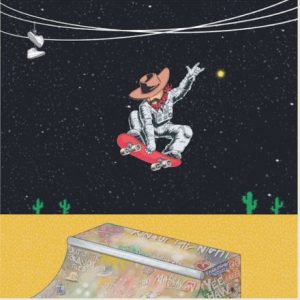
As the first release from the first artist signed to Southland’s first record label, Lachie Hayes’ album ‘Subsatellite’ already comes with its own legend attached. Add to that the production input of Lyttelton’s legendary singer-songwriter Delaney Davidson, and the possibility of some sort of Kiwi southern alt country spectacular might reasonably be imagined. Right from the cosmic skateboarding cowboy cover imagery Haye’s debut album delivers just that. Richard Thorne talked with him about taking the time to get things right.
Despite having lived his life within a country mile (well, certainly fewer than 100 of them) of Aotearoa’s ‘official home of country music’, and having been a musician for pretty much all those 29 years, the Gold Guitar Awards-style of music isn’t what spins Southland singer-songwriter Lachie Hayes’ wheels.
“Blues music is my ultimate, that’s where my soul lies,” he says, “… but country music seemed to be the direction where the songs I was writing got steered into. I’m a blues fan, but I have no African-American roots or heritage, and for me to do that would be somewhat inauthentic, I think. But in a funny way country music is super authentic. It’s something that has bled very much into the culture here in NZ, certainly a lot more than blues music has.”
Hayes’ own musical heritage traces back several generations, including his parents’ group, Run The Cutter, being nominated for Best Folk album at the NZ Music Awards in the early 2000s. Their songs, he says, were “all very south”, often based on grim tales of this country’s past, like Minnie Dean and stories about whaling.
Growing up on a sheep farm in the Catlins, much of the family social life revolved around music, and he recalls weekly trips to the country music club in Wyndham (where he now lives and works as a teacher), about an hour from home. Everyone had to perform, and his parents would be part of the band helping others perform their one song of the night. His skills on harmonica stem from those early experiences.
“I actually hated being dragged to country music clubs as a kid. Now when I look back I’m very thankful for it. I think they’re a wonderful thing, a place where people can go to just sing, regardless of your talent or ability. But those kind of music clubs are sadly a dying breed.”
Hayes’ debut EP, ‘Where The Shadows Hang’, was simply produced with just his guitar, harp and voice, but proved good enough for him to be named Southland Entertainer of the Year at the 2018 Southland Entertainment Awards. He also won the Album and Song of the Year accolades.
It’s been a long gap to the 2025 release of this debut album, and really, not much has changed in terms of his widely-ranging songwriting – alternative country, folk-infused blues is the best saddle blanket to throw over the tracks on ‘Subsatellite’.
What has changed significantly is the degree of production, with the introduction of equally nuanced instrumental detailing that kicks in from the first off-kilter bars of poison pen opener The Likes Of You, and doesn’t let up through the album’s 11 character-filled tracks. Edgy, often unsettling guitar sounds, saturated tremolo, and jaunty organ frame these stories as much as his lyrics.
‘I am a subsatellite baby,’ Hayes sings with clarity and weight in the effects-dripping, swampy southern-blues track which gives the album its name . ‘I got wheels within wheels… feels within my feels.’
“I guess that is the most autobiographical song in the album,” he affirms of Subsatellite. “It’s the whole nature of being a musician down here, and looking at that world out there that’s seemingly out of reach, that we’re orbiting in Southland – which is kind of how I feel about creating art down here in the deep south of NZ. It’s not America… it’s not even Auckland… and we created an album! So that’s us, we’re a subsatellite, a barren wasteland orbiting the fringes of the fringes, and doing our best.”
‘You can’t put me in your pigeon-hole, you can’t tie me up with string,’ the lyrics continue.
He’s a gifted storyteller in song, with lyrical dexterity that allows him to tell engaging three-minute tales that simultaneously manage to have one boot in an old western movie and one in present day rural Aotearoa. And he does a fine line in cowboy country, as witnessed in Lonesome Hearted Lovers where ‘central’ fills in for those wide-open American prairies, but any country sensibility is aimed beyond the fringes of radio’s routine.
“Yeah, we strived very hard to be a full length away from what is considered Nashville mainstream country. I enjoy country music, but mostly from a very retro perspective. I’m talking George Jones, Loretta Lynn - Jimmie Rodgers is probably my favourite country musician of all time, and he died in the ‘30s, so not contemporary country at all!”
The ‘we’ presumably refers to his album’s luminary producer, collaborative musician Delaney Davidson, whose own music brings a determinedly alt approach to a similar catalogue of blues and country sub-genres. It was Hayes’ friend and music enabler Blair Savory, (the ‘Sav’ of Massav Productions and now Massav Records, Southland’s first record label), who had the smart idea of asking Davidson to produce the debut Lachie Hayes album.
As a regional event promoter Savory had worked with him on a few occasions, and rightly predicted their chemistry would be good. However, it was a prior encounter between the two singer-songwriters that swung the deal. Actually, the three musicians – Jimmie Rodgers was also involved.
“I had met Delaney before, when I was basically playing background music at a post-party sort of event to do with Gold Guitars and the Tussock Country thing in Gore. They had asked me to play some acoustic country music in the background.
“Nobody’s listening, or at least that’s what I thought, so I played some old songs that I love, like I’m Free From The Chain Gang Now – nobody cares, right? Then Delaney Davidson comes up at the end and says, ‘I really appreciate you playing Jimmie Rogers and those songs from the ‘20s.’ And I was like, ‘Well, thanks. It’s great that you’re listening,’ and I got to have a great conversation with him.”
It was around a year later when Savory suggested hitting up Davidson and see if he would produce Hayes’ album. A version of the album had already been recorded, but Savory was looking at a bigger picture.
“Delaney didn’t really accept very forthrightly, so Sav sent him a video of me playing, and he realised I was that guy that played the Jimmie Rogers’ song in Gore!”
Hayes admits the two musicians did have the odd clash of opinions, but describes it as a wonderful experience.
“What I love the most about the album is probably that it is so varied in genre, but so cohesive in style. And that was Delaney, that sound and that feel that goes through the whole album, despite each song having a completely different genre almost.
“It’s really country, there’s really blues, and some really hard rock on there, yet it all flows and feels the same enough that, as a listener, it’s not jarring. I think that Delaney’s real magic was he was able to keep that thumbprint there the whole time, something that I would never have been able to do.”
 Inevitably some songs are drastically different to what had been demoed.
“Subsatellite is the greatest example of that. It was just a strummed acoustic, quite jaunty sort of a song that was very similar to Love Minus Zero/No Limit, by Bob Dylan. Delaney said, ‘We’re going to slow it down, and we’re going to make it this really sleazy rock.’ He completely flipped that, changed the entire style of it with a kind of drunk-style guitar.
“But for the most part, no, not really. He changed the textures more than anything, added layers that I would never in a million years have thought of, and I’m so grateful for him being able to hear something I wouldn’t have.”
He describes Davidson as an enigma and a chameleon.
“You can’t always tell if he’s joking or not, but he’s incredible to watch work. You get the sense of the cogs turning in his head thinking about things during the day, and then he adds something in the studio and you go, ‘What, a bongo? Where did you pull that idea out of?’ And it’s on there, and it’s brilliant!”
A studio band of musician friends meant they had the luxury of trialling tracks in different styles. Invercargill drummer Matt Ward and veteran Dunedin bassist John Dodd made up the rhythm section, while Hayes’ dad Steven Hayes added violin and pedal steel. Tracking was done live over five days, with further texturing subsequently added in a session at Sublime Studios almost a year after. Southland country music star Kayla Mahon adds harmonies to Fire In My Heart, while Melbourne-based Kiwi musician Oscar LaDell features on Easy To Fall For You.
“Having Kayla, there was great. We really wanted to get a nice female vocal like that, a flowery female style vocal over that as a kind of quite gentle, soft country song. We talked about that kind of Tammy George Jones sound of country vocals shared that we wanted to do. And Oscar is a really good buddy of mine, and a phenomenal blues guitarist. We had this total blues song and it was really important for me to get Oscar on there.
“It made us laugh because Delaney was in the studio saying, ‘You realise when you guys sing this it’s going to sound like you’re in love?’ And we were like, ‘Yeah, that’s alright. We’re fine, let’s let the listener interpret whatever they want.’”
The owner of just a few guitars, a couple of acoustics and a 1970’s Ibanez electric that a generous uncle gifted to him years ago, Hayes is the opposite of being a gearhead. He admits being prone to accepting the guitar tone he’s got, rather than spending time chasing something special.
“I get pretty bored quickly with tech speak, and I get a bit antsy like, ‘Alright, can I just play now?’”
By contrast, Delaney Davidson is an award-winning master at embodying the mood of songs with matching swagger, typically dark’n’dirty guitar tones and vocal effects. The sorcerer and the apprentice maybe, in which case the shared alchemy was indeed golden. As per his ‘feels within feels’ lyric, ‘Subsatellite’ is an album that keeps on revealing more.
“Well, I am known to do things by half, and I was extremely lucky that Blair Savory decided we should record these songs and take it seriously. It’s nice to have somebody backing you. The goal for the album was to produce a work of art. You know, we get to hold this record and say, ‘Look what we’ve done. We were here on the planet.’”
That’s maybe the father and school teacher coming through, but with ‘Subsatellite’ this already award-winning Southland entertainer embraces the thrust necessary to extend his orbit.
“Ultimately it would be great if songwriting and performing music could be my main income. That’s kind of a pipe dream in NZ yes, but this is the thing I love doing, and if that could be my job that would be amazing.”