
Industry: The Cultures and Musicians of This Place Here
Industry: The Cultures and Musicians of This Place Here
‘Diversity and Collaboration’ was the title of Michael Hollywood’s feature on then-emerging four-piece Yoko-Zuna for the Feb/March 2016 issue of NZM. Those concepts are obviously important to drummer and filmmaker Swap Gomez; they lie at the heart of his latest project, a one-of-a-kind documentary series titled ‘This Place Here’. The ambitious project is an exploration of Aotearoa’s minority cultures and their music, that also culminated in a performance at Auckland’s CultureFest in April 2025. Nur Peach investigated for NZM.
Swap Gomez has developed quite a reputation as a drummer and drumming advocate. He’s currently part of Chaii‘s touring band, and as a member of Yoko-Zuna has toured with such names as Ed Sheeran and The Veronicas. His filmmaking has developed alongside his drumming, skills he says he learnt out of necessity.
“Within Yoko-Zuna I found myself taking on that role of director/editor/video producer, because we just couldn’t afford anyone else to do that for us. And then once I did that other people started asking me to make their music videos, but documentary was the other thing that I always wanted to do.”
Gomez’s first foray into this world was a doco for Netflix which was never released due to Covid. His next would begin in October 2023, at his annual Drummers Day Out event staged at Otara Music and Arts Centre (OMAC) in Tāmaki Makaurau. Due to his Bangladeshi roots Gomez grew up playing with practitioners of traditional instruments such as tabla, harmonium and sitar. That year, he invited a tabla player he’d known since he was 11 to be a part of Drummers Day Out. It was the first time they’d included tabla, and it sparked a conversation with his friend Gene Rivers, a DJ who also works in arts, culture and heritage at Auckland Council.
“He asked me, ‘If we were to come up with something to tell these stories of different cultures coming together, how would that work in a musical sense?’
 This became the initial idea for ‘This Place Here,’ a cover-all project which takes its name from Yoko-Zuna’s 2016 debut album. Gomez says his first thought was to hold a SongHubs-style collaboration session involving people from various ethnic backgrounds, but he decided against because there were too many potential problems.
“There’s not just the language barrier, but there’s also the musical barrier, because all the music stems from different traditions, and if we just put the musicians in a room, it might actually be more detrimental than we think. Or it might be amazing – but we weren’t wanting to risk it!”
They ended up deciding on a documentary format centred around interviews of traditional music practitioners from various cultures. Apparently, this idea emerged from another conversation with Rivers, who ended up playing a key role in enabling the project and securing funding.
“I was like, ‘What if we just find these communities, and ask them in a research way what their needs and wants are?’ And how they feel in a community where otherwise there’s no representation, or it’s very token or in small pockets.”
Gomez began searching for musicians and groups to interview with the aim of covering each continent base, ending up with 18 different cultures represented. The colourful all-ages cast of ‘This Place Here’ includes his own father, singer and harmonium player Leonard Shekhar Gomes; a group from east Russia who play a jawharp called a khomus; Indian tabla player Basant Madhur; a taiko drumming group; taonga puoro practitioner Marcus Winter and others.
The documentary production began in June 2024 and took two months. The process involved Gomez and his camera operator, Gilbert Rae, visiting the different musicians and groups. He would conduct interviews, asking questions geared towards his research goals.
“I started off by just asking the instrument that they play? And what that led to was talking about the meaning it had to them to be able to play, and also being migrants of indigenous background, they were talking about how much it was part of their identity. I wanted to avoid asking what they thought about the music industry. It was just genuinely what they loved about their instrument and the history of the instrument – and for them to practice their instrument in New Zealand what could be done better. What were their needs and wants? So it was pretty straightforward questioning, but the stories that poured out of that were fascinating.”
A report produced alongside the documentary detailed his findings. Gomez’s hypothesis had been that everyone was working in their own spaces and would want to integrate more. He was surprised to discover a desire for collaboration across the cultures.
“Everyone was keen to work together, but they just didn’t know how because so much of it is sort of Western-based, dominated and also run by Western people.”
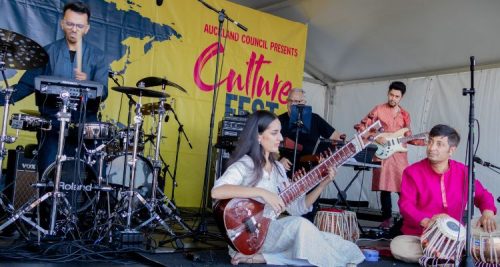
This discovery sparked the idea for phase two of the project, which became a collaborative performance. A simple enough idea on paper perhaps, but really an ambitious concept considering the languages, cultures and technical challenges around the extreme diversity of acoustic instruments involved. This performance involved some of the musicians interviewed in the documentary as feature artists, with a backing band consisting of Stephen Small, Alan Brown, Kenji Iwamitsu-Holdaway and JY Lee, and naturally including Swap Gomez on drums. Rehearsals were held over five days leading to a performance on April 6, 2025 at the Auckland Council-backed CultureFest. Both the rehearsals and concert were filmed.
“Basically we said, ‘Let’s play what you guys want to play, and we will add some spin on this in terms of instrumentation.’ And it was really fun! It was such a moment when everyone was playing altogether!”
With post-production and editing of episodes of ‘This Place Here’ continuing, Gomez mentioning the possibility of a third phase for the project, though he isn’t yet sure what exactly it might entail. He does know it will involve finding a way to give the project a lasting impact.
“I think it would look like a bit more experimentation. How do we get these this type of music, or how do we get this type of collaboration to be more seen in something like NZ On Air, or recorded music, or like the music awards? Basically figuring out how to keep this sustainable.”