
Book Review: The Happy Prince (The La De Da’s)
Book Review: The Happy Prince (The La De Da’s)
At the time, the psychedelic 1969 album ‘The Happy Prince’ by hit-making Kiwi band the La De Da’s (Hey Baby, How Is The Air Up There?) was hailed in Aussie music magazine Go-Set as ‘the best thing ever recorded in Australia’. Yet the album, was barely promoted, never charted and became ‘lost’. That line up of one of New Zealand’s most loved bands of the era didn’t record another album. This book tells the story. Reviewed by Martin Walsh.
The Happy Prince
A lost album is only as valuable as the number of people who need it. John Tebbutt clearly needs ‘The Happy Prince’, and by the end of his slim, scrupulously researched entry in the 33⅓ Oceania series, you will too.
The La De Da’s were never short of nerve. Ray Columbus & the Invaders had already shown, with She’s a Mod that a Kiwi band could cross the Tasman and make some noise. The La De Da’s answered in 1966 with How Is The Air Up There?, their first professional recording. It was a sly swipe at social hypocrisy that became a Kiwi My Generation, and a seam they would mine again three years later, this time entirely in their own words.
In early 1969 this band of young New Zealanders did something no one in Australia had yet tried. They built a whole album around a single story, Oscar Wilde’s fable of a gilded statue and a devoted swallow. In doing so they pulled up a chair alongside ‘Pet Sounds’, ‘Sgt Pepper’, ‘S.F. Sorrow’ and ‘Tommy’. It was a wero thrown down in the spirit of Hillary and Burt Munro.
Tebbutt never loses sight of the people behind the record and his eye for detail is a joy. Hair is cut with fabric shears in the back room of The Casual Shop. A mum opens an account at Vance Vivian. Eldred Stebbing, the closest thing NZ had to a Colonel Tom Parker, presides while his son Robert builds homemade fuzz boxes. Peter Grattan remains awestruck decades later by Bruce Howard’s Ekosonic organ and Brett Neilsen‘s colossal ride cymbal. It’s a time capsule, immersive yet held with a scholar’s steady hand.
That steadiness serves the book well when the story turns tortuous. The band spent 18 months in Australia without recording a note. A session at Adelaide’s Gamba Studios was bankrolled by Penfolds’ heir Derek Jolly, and came complete with one of the few Moogs outside of America. It collapsed while the band were already on the road. Yet the music kept growing. By the end of 1968 their arsenal ran to Hammond, Fender Rhodes, sitar, bagpipes, mandolin and cello, and Go-Set readers had voted them Australia’s best disco act.
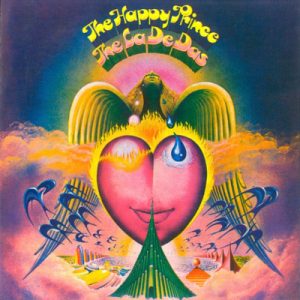 When the album was finally made, it was in EMI’s Sydney studios, and that was not the band’s first choice. Producer David Mackay preferred Bill Armstrong’s Melbourne operation, and fellow Kiwi Howard Gable likened Sydney’s studios to a hospital rather than a rock’n’roll joint. Needs must. Over four weeks the band cut the record, wrapping it on 25 February 1969. Go-Set’s David Elfick judged it a creative leap beyond anything Australian pop had yet produced.
Then there’s Adrian Rawlins – poet, prodigy, cosmic hobo. His plummy theatrical narration makes him the greatest Doctor Who the BBC never cast. Tebbutt’s account of how the band found him is one of the book’s delights. They may well have caught one of his performances, perhaps the night he recited Howl, semi-naked, at Sydney University. Asked when Rawlins was engaged as narrator, Kevin Borich‘s answer is perfect, “He was already there.”
Molly Meldrum predicted that by the end of 1969 the La De Da’s would leave Cream, Traffic and Hendrix in the shade. Instead, with characteristic independence, the band flew to London – managerless – in June. EMI’s attention was firmly on The Beatles. By the time the band returned, the Australian press had moved on and their brand of interpretive rock had been overtaken.
Tebbutt tells this with tenderness rather than regret. He calls the album the product of “serendipitous camaraderie between a garrulous hippie and a band of musical brothers”, and a testament to pioneering New Zealanders and Australians alike. Its commercial fate only sharpens what he makes us feel; it mattered, and it still does. This is a book for the devoted that makes converts of the curious.
Read it with the record playing, and let Rawlins be your guide. You’ll find this modest volume is, like all the best time machines, much bigger on the inside.