
Alan Brown: Ondomo Freestyling
Alan Brown: Ondomo Freestyling
‘Encircle’ is the second album renowned Auckland jazz pianist Alan Brown has produced, composed, recorded and mixed with the exotic Ondomo electronic instrument at its centre. Less compositions, these tracks emerged largely through his exploration of the random interplay of contrasting sounds and textures, inspired by generative audio systems. As the album notes observe, Brown has employed the collaborative improvisational language of jazz within an interactive technological environment – to make a record that celebrates stillness. He talked about the new album with Richard Thorne.
Along with a near full-time role at Auckland’s SAE Creative Media Institute, which includes both teaching and administrative responsibilities, Alan Brown is kept plenty busy as a specialist vintage electronic keyboard technician. When we talk on a sunny September Monday he’s just returned after a weekend gig at The JazzLab in Melbourne, a there-and-back trip to perform with Takadimi, the innovative Indian classical music and modern jazz fusing act led by master tabla player Manjit Singh. While his days performing with contemporary acts such as the jazz-funk ensemble Blue Train may be in the past, Brown remains in demand as a quality keyboard player, a versatile and hugely knowledgeable musician.
We’re in his small office-sized home studio to talk about his new album ‘Encircle’, released on the Rattle label. It’s the second album that he has completed with the curious instrument he alternately refers to as an ‘Ondes Martenot’ or ‘Ondomo’ – the first being the name accorded to it by French inventor Maurice Martenot back in the 1920s, and the latter being the elegant handmade modern Japanese version he purchased almost a century later. By either name it’s one of the earliest electronic instruments, and quite likely the only one in the country.
The very potted origin story is that Martenot and another inventor, Leon Theremin, were independently experimenting to find a way to control and use tone oscillators, such as they’d each used in war time radio operations, to create sounds. Theremin patented his now famous twin aerial device in 1928, but to Martenot’s reckoning the hand-waving approach was way too imprecise. He was a cellist and wanted the same fine degree of pitch control and expression he could have with his cello.
Martenot’s electronic keyboard instrument is both visually and aurally fascinating, but the manufacturing and playing complexity, especially in comparison with the Theremin, meant it languished as a clever, costly and exotic rarity.
Of the few hundred he built, Brown thinks there are likely only about 60 Ondes Martenot originals still in working order, with Radiohead’s Johnny Greenwood being the most famous of current users. Fans of the 1960s Gerry Anderson puppet series like Stingray and Thunderbirds may recognise the instrument’s eerie sound. Dr Who is another more familiar example of its handy sci-fi applications.
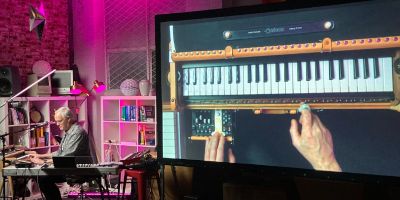
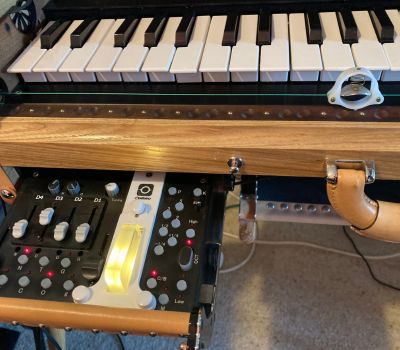
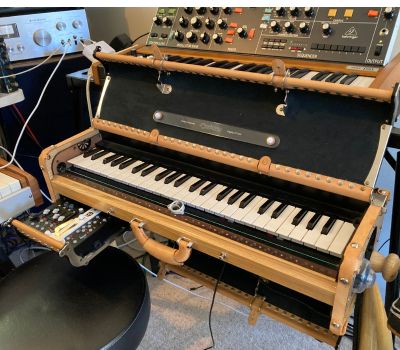 Brown describes the ring device and string visible along the front of the keys of his modern replica Ondomo as being like a cello fretboard, while a lever nestled in a drawer amongst other controls below the left hand, is akin to the bow. He put his name on the waiting list for one in 2021, a few years after discovering the unusual instrument during research for his sound art class.
In August 2023 he released an album titled ‘Ondulation’, 10 instrumental tracks (‘contemplations and improvisations’) in which his Ondomo took a lead role as the main melodic feature, as he explored and demonstrated what this exciting non-MIDI-able monophonic instrument could do.
Two years later on sees the release of ‘Encircle’, much more an album of reflective, ambient and atmospheric music tracks. His growing familiarity with the Ondomo has led to Brown exploring new opportunities with it, and all the music here is very much improvised, rather than planned in advance.
“I think I’m a lot more confident, and not afraid of breaking the rules, as it were, in terms of the traditional way of playing this instrument, which I quite enjoy.
“This time around I was just trying different things, putting it through bunches of effects and just seeing what other sounds I could coax out of it, that could go into more layered aspects to the tunes. Not so obviously as an instrument on its own, but more I guess processing in a way, producing other tones beside its own. And then that becomes a bed, or an atmosphere, while other things are happening around it.”
He made use of various app-based generative processes, one of which he describes is being similar to the old idea of non-synchronous tape loops, where several repeating sequences evolve, producing collisions and layers.
“Or else it might be an algorithmic approach, where I’d set up a random note generator type thing, setting probabilities of which notes will occur when, in what range, and so on. Then I might build on and add to that. Rather than necessarily having an end destination in sight, it was getting these things to evolve, and often I’d just capture a segment of that evolution, take that bit out and start mixing it around.
“In this context it’s more the process of discovery in many ways. I might discover a particular sound, and that might be an inspiration on its own. ‘What am I feeling from this? Where can I go with it? What can I add?’ Maybe record it, set some things up, come back. ‘Oh, yeah, that worked’, or not. And then I’ll just add to it or subtract, it’s a very organic process.”
 While reluctant to term the 10-track album meditative, he admits that the creative process was in itself a form of meditation for him, where he would set up processes and allow the music to work itself, while he just listened, or perhaps read a book.
“With this I’m allowing myself more freedom to not be so tied up into a structure. I’ve been more open to the longer form – which is a big thing of ambient music anyway – and allowing things just to sit there and slowly develop, without forcing it in a particular direction.”
The 10 tracks range in duration from four to almost 11 minutes, with titles like Almost There, Bioluminescence, Isolation Tank and Between Thoughts capturing the sense of evolving stillness. It was, he admits, a period with lots of challenges in his own personal life, as well as for others close to him dealing with stress, depression and anxiety issues.
“I found that sitting down and starting to create this was a way of releasing some of the tension I had from that. I guess why some of it is a little bit more long form, and maybe a little bit more still, is because that was what I needed to do as well. And I don’t know why I chose ‘Encircle’, I guess it’s just like that journey that was happening at the time.
“For me music is a way of expressing and letting that out, where I might not be able to in another form. And I find with this sort of music it’s very emotional for me, so it’s ideal. Jazz can be exciting and dynamic, but there are times I just need to sit and be very still, and ambient music sort of fulfills that.”
The closing track, Isolation Tank, notably features a progressive sonic erosion, in homage to William Basinski’s recordings ‘The Disintegration Loops’.
“Basinski was trying to digitise old tape loops, but the ferrous oxide was falling off the tape so he was capturing all that disintegration over a period of time, which is actually fascinating to listen to. Being released just after 9-11 it was quite a poignant statement on that, but in a very still, reflective way.”
For his Isolation Tank Brown used a plugin developed by experimental German composer/artist Hainbach, which he describes as being like the old eight-bit Sound Blaster soundcards from early video games.
“So it has a sound-on-sound feature, and also this low bit quality decay feature that was really fascinating.”
The longest of the album’s tracks, it’s also the most personal for him, one he felt needed to be included.
“I was trying to capture that sense of isolation, or loneliness, or whatever. Having gone through my own experiences like that in the past, it was a cathartic way of expressing that for me.
“Without trying to be melancholic or anything, at the end of it there is just a long tail of slow, sort of moving texture, which I found really comforting. So, after all this sort of disintegration and tension it becomes this stillness. You’ve let that all that go, type of thing.”
 The release of any album is a letting go for the artist, a point where the industry and commerce take over from the creativity. ‘Encircle’ is available online via Bandcamp, not on Spotify. Having previously released an album of Ondomo music Brown is well aware that return on investment is not something that can be expected from such niche ambient music releases. Rather, once finished it needs to be released.
“I’m constantly sitting here and putting ideas down, recording them… coming back to them. I’ve got at least another two or three albums of stuff just sitting there, slightly unfinished, some finished, but waiting to find the right place for them.
“I guess with this album, I came to the point sometime early in the year of, ‘Yeah, this is pretty much what I want to get out there.’ For me it has a cohesiveness, and I need to do something with that, or else I won’t, right?”