Jason Parker: Cometh The Hour…
Jason Parker: Cometh The Hour…
“What makes a man?” asks Jason Parker in his rainbow-bright, effervescently candid debut album. The Tāmaki Makaurau pop artist and actor has seen a fair bit of success having released two EPs, charted on the Hot 40 and NZ Hot 20 Singles charts, and appeared in both X Factor and Popstars. Released in November 2026 the album marks the start of a new era, a queer coming of age story with consistent themes of self-love and empowerment. He talked about it with Nur Peach.
Gearing up to release his debut album Jason Parker is excitable. The bubbly personality that matches his upbeat electro-pop style is on full display, augmented by the anticipation of this big career moment.
“It feels amazing,” he grins brightly. “That’s every artist’s dream. Even though I’ve been working on music for quite a few years now, I feel like everything I’ve done before has been leading up to the moment of the debut album.”
Since his first single dropped five years ago Parker has been a prolific recording artist, and is no stranger to the long-player release process. Two prior EPs, ‘How to Be Lonely’ (2022) and ‘Fairy Bread’ in 2024, were acclaimed and loved by fans, paving the way for this release.
“I was learning about what I wanted to say and what I wanted to sound like, so when I got to making an album I felt more comfortable in my ability to know myself, and know what I wanted to say. I just really doubled down on the sound that I had already been working on, and honed it. I feel like this album is more grown up, and the things that I’m saying are more true to me.”
Much of the album’s appeal stems from the crisp, sparkling production of Maude Minnie Morris, which provides a professional artist polish throughout. Parker and Morris met through his Auckland recording label BigPop Records, and previously worked together on ‘Fairy Bread.’
“Maude has such a good sense of pop music,” Parker gushes. “She’s been in the music industry for a really long time, and she loves pop as well. We would just geek out about pop music! I think that really helped create these really luscious backdrops to the songs I was writing. She is part of Jason Parker just as much as I am.”
 While he mostly took care of the songwriting and Morris the production, they collaborated in each area.
“Sometimes I would bring in the songs and then we would create the production around the music I’d brought in. And sometimes we would start completely from scratch.”
Dynamic mid-album track God Forbid was one of the songs they wrote together. Sparse verses featuring a stream-of-consciousness style vocal delivery contrast with an upbeat, hooky chorus where Parker sings, “God forbid I love myself enough to be better.”
“God Forbid was the final song we wrote for the album,” he says with evident pride.
“I know you’re not supposed to have favourites, but it’s my current favourite on the album. It’s about that feeling of choosing anything else other than loving yourself, and going for the wrong person.
“It’s specifically about this situationship that I had got myself in, which, from the get-go, I knew was red flag city! But I couldn’t get out of it, and then when I did finally get out of it, I wrote that lyric, ‘God forbid I love myself.’ Like, why would I choose the hard road, instead of just loving myself? Why is loving myself the hard choice to make?”
Other tracks, including Good Judy, took more trial and error. The disco celebration which features an energetically strummed acoustic guitar and frenetic strings, started off very differently.
“It was gonna be this country pop banger!” Parker reveals. “I wanted banjo. We tried it, and it was such a flop, but I still believed that the song was good. So, then we scrapped that production and we started new ideas – until we finally landed on this really lush disco strings instrumentation. Once we did that we were like, ‘Oh, this is the song!’”
It’s evident across the 10-song tracklist that Parker and Morris have a strong musical connection. They have produced a strong genre-traversing collection that carries a clear, intentional coming of age theme. Parker sings to his own experiences, and the experiences of those who don’t conform to gender stereotypes.
“The album title, ‘What Makes a Man,’ is a question as well as a statement. It’s ‘What makes a man?’ and ‘What makes a man…’ It’s about me going on this journey, trying to find connection and belonging. There’s a lot of pressure to be a certain type of way, and a certain type of man, or a certain type of person, and when you take that pressure off yourself what is left?
“I also wrote it or my friends and my family. It’s an album for them and the people who believe in me. Those are the people that made me the man I am today. It’s a queer coming-of-age story.”
The heart-wrenching title track, a 5min 39sec ballad which starts with acoustic guitar and builds towards an unexpected climax with layers of filtered vocals, is undoubtedly the album’s thematic cornerstone.
“When we finished it Maude just looked at me, and she goes, ‘I think this is the name of the album,’” Parker beams. “Everything else we’d been writing before came to that perfect moment in What Makes a Man. It’s the most ballad thing I’ve ever done. It’s super stripped back, there’s hardly any backing vocals, there’s just a guitar.
“Me and Maude recorded the guitar and the vocals at exactly the same time, which is not common when you’re making pop music. We wanted that feeling of, like you’re in the room with us, listening to me pour my heart out. Then it just releases and becomes this inviting moment where everyone can just feel warm – and it feels like a big hug, and you can just let go and dance! I really have hopes that when I finally get to perform the full version of What Makes a Man live, that the whole room is just dancing by the end of it, together.”
The lyrics are some of the most revealing on what is already an open-book album.
“It’s like I’m still stuck on the mud on the playground / and all of the boys turned to men and they left without me,” Parker sings.
“I grew up in rural Hawke’s Bay, and I definitely had a moment where I was becoming more myself and realising that I was different, that I was queer, that I was flamboyant… And that meant that I lost a lot of friends when I was young, so ‘stuck in the mud on the playground’ is kind of real, and I feel like other people have been through that exact same thing.”
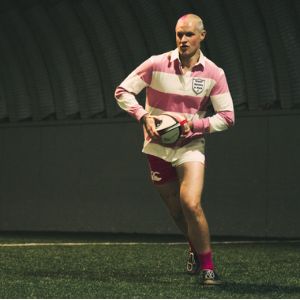
That Parker was able to have some fun with the deep and personal themes is made evident with the pink-and-white striped rugby jersey he sports in the lyric video for What Makes a Man.
He also references his hometown in Glory Days, a cinematic track where he channels Ed Sheeran in a touching tribute to his home and family.
“I wrote that song about the feeling, which I think a lot of New Zealanders, and people who’ve moved away from the home they grew up in will relate to – of having to leave home to go and find yourself and be your best self. And having to leave behind all the people who know you the best and love you and taught you everything you know, and missing out on watching them grow up and live their life.”
Released in September, One Week Sober was the album’s introductory single, and squarely addresses the question of ‘…am I enough?’ without the crutch of habits previously relied on to define himself. Opening with a plucked synth line that immediately sticks in the head, the song was born out of a session with Chris Bates and Will Henderson. It began, he says, with a true story, but was never really about drinking.
“It was the first time that I had ever done a writing session – and I came out of that session feeling like we’d written something bad! But Chris had made this cool riff, which is in the opening. I really liked the riff, and at that time I had a broken collarbone and I was feeling so sorry for myself.
“I’d quit drinking for the first time in my whole entire life, because I just needed to recover… and I was just thinking about that a lot. So then I was like, ‘Oh, maybe I’ll write about this,’ and the first line that came to me was, ‘I’ve been sober for a week, and all I’ve thought about is celebrating with a glass of wine.’”
Delivered matter-of-factly the lyric kicks open the song which he later completely rewrote, turning it into a bouncy slice of Top 40-style electropop, with a deep, introspective message about building self-worth rather than turning to alcohol. What starts as a self-pity builds and breaks through as Parker repeats, “I am enough,” until he thinks he believes it.
“I really needed to hear that I can do this, and I am enough, and I wanted it to be like a mantra for myself to get through that time. And even now, I sing it, and I’m not in that headspace at all, and I still feel really powerful!
“The reception that I’ve had from it is the same. Watching people sing back at me when I’ve sung it live is so amazing. Everyone’s yelling, ‘I am, I am, I am, I am enough, I am enough…’ It’s so awesome. It just feels liberating.”
Parker loves these moments with his fans. He couldn’t not include a tribute to them, which is the effervescent, compulsively hooky synth-based Miracle.
“It was the first song that I’d written straight after I finished ‘Fairy Bread.’ As a songwriter, once you finish a song you’re worried it’ll be the last one that you ever write! I was walking around just being like, ‘Oh my god, I’m never gonna write another song again.’
“And I was thinking about all the people that have supported me up to this moment, and how much I loved singing live, and that I loved being at a show and seeing everyone’s big faces, and I just wanted a song to say thank you to them.
“I can’t wait to sing it live, because I will be singing it to my fans. That’s the miracle I’m talking about. They are my miracle.”
Made with support from NZ On Air