HINE: Walking Back Towards The Future
HINE: Walking Back Towards The Future
Multi-instrumentalist GiGi Crayford (aka HINE) grew up immersed in music and culture in Te Whanganui ā Tara, a mokopuna of the ‘Crayford jazz dynasty’, as her musically gifted family have been described. She has been a multi-dimensional artist her whole life, more recently known for her soulful voice and captivating stage presence. Following three years in full immersion te reo Māori the extraordinary ‘KA MUA KA MURI’ EP by HINE draws from her experience of tracing whakapapa, connecting to pūrākau and the Māori world.
The title is drawn from a traditional Māori whakataukī (proverb) translatable as ‘walking backwards into the future’. Musically the EP blends indigenous folk, jazz and poetry in honouring different atua wāhine (female deities) with waiata in both te reo Maori and English.
“The whole instrumentation was played by my family, drawing from the wellspring of whakapapa to support the story and journey in a deeper way.”
Of Scottish, Irish and French ancestry, HINE is also descendant of Ngāti Kahungunu ki te Wairoa, Tūwharetoa and Ngāti Raukawa ki te Tonga, with ancestral links in Ōtaki where she recorded her EP – a project which had its start five years ago, the first mesmerising single, Ka Mua Ka Muri, released in 2024.
Employing the full theatrical range of her enigmatic vocals, HINE was joined by her brother Miles Crayford playing organ and Rhodes piano, while her father Greg Crayford was on drums. Interwoven with the ancient sounds of taonga puoro, some of which she carved herself, the five-track project is a contemporary genre-bending experience that builds seamlessly in places to soaring ecstatic moments with strong echoes of Pink Floyd, before descending back to spoken word.
Engaging and entertaining throughout, the creative breadth of the EP has a sense of being a piece of theatre.
I love that comparison. I think music is really the ultimate art because it can contain all arts if we like. I am a multi-dimensional artist, visual, musical, a story teller, a dancer… I wanted to express and explore as much of my creativity as I could in this process and really allow the spectrum to be there.
I love the theatricality of story telling too and think it’s a really vital part of these songs, using the talking voice as well as the singing voice, the karanga voice as well as the voices of all the instruments, western and taonga puoro alike. This creates a sense of theatre and dynamism to the project.
Care in the process must have been integral in allowing (and containing) the theatricality. What were the core strands of process you followed?
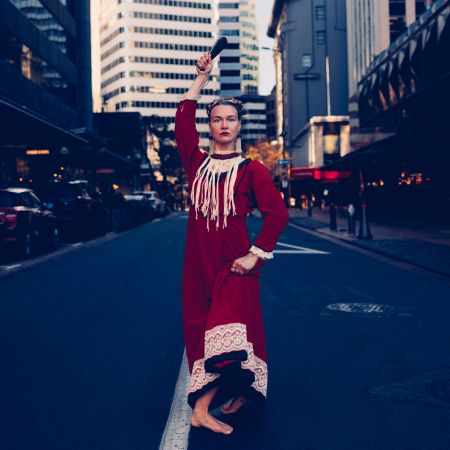 Process is almost the whole reason for this project. I’m infinitely fascinated by the way art creates us as we create it. We are tempered and changed by the process of creating art, leaving us changed and different on the other end.
I feel like art is also divination and prophecy, a practice of opening and traversing portals that can evolve and expand us, mold and re-build us. That’s been so for every part of this project, it’s a very spiritual practice, a practice of faith, curiosity and devotion.
When I show up to create, I (try at least!) to show up without expectations but a willingness to listen, explore and express without judgment or pressure on myself or anything to be anything other than what is true, authentic and alive in me at that moment.
This process of writing, recording and producing this EP was an anchor as I was in three years of full immersion te reo Māori at Te Wananga o Raukawa in Otaki, pulling on threads of ancestry and learning things, touching parts that hadn’t been touched for generations in my family. It was hugely confronting, challenging yet also some of the most rich and meaningful experiences in my life.
The core strands are ones of expression, spirituality and connection. They are a vital part in every song and the foundation of the whole project. Expression because I am one of those people that need to externalise, express in order to process my feelings and the goings on of life, that naturally comes out as art, music, some of which I feel are fit for consumption and may resonate or have something to give others.
This is what also lends itself to the theatricality of this project I guess. I’m a flamboyant kind of gal! These songs are all expressions of sense making, meaning making and assimilating the process of learning more about where some of my blood comes from and what belonging means to me and the people I come from.
The title track Ka Mua Ka Muri was the first single released, but is the last song on the EP. Why does it fit at the end?
Ka Mua Ka Muri was actually the last song written for the EP. Over The Bones is the oldest, written in 2021, and Hinetakurua has its origins in 2021 as well. Ka Mua Ka Muri though was the first to be released because in itself contains the ngako (essence) of this whole project. A journey back home to the earth, to remembering and reclaiming our place amongst nature.
All of the songs were recorded at the same time as Ka Mua Ka Muri in the summer of 2023 – knowing the whole time we wanted to do an EP and that it would be called ‘KA MUA KA MURI’. There’s something in the fact that it’s the last song on the project but the first to be released, the time-bending nature of the concept of Ka Mua Ka Muri itself (some translate it to walking backwards into the future). It felt only natural to begin but also close the project.
Each track has distinct elements of language use, singing and poetry, a range of music genres etc. What did they start from? Was it songwriting or perhaps a story board of ideas?
Each song had a completely different process in terms of what started it. It’s been very intuitively led most of the time, allowing the natural process of the piece to let me know how it wants to be expressed, formed and created and tempering and teaching me during that process!
One of the songs, Over The Bones, came to me in a dream after a road accident I was in. In the dream I was surrounded by a circle of women in the forest and I knew they were ancestors delivering me healing through their visitation.
Arahina Mai (which means lead/guide me) was one of those songs that arose out of a feeling of seeking, and a sense of being lost and challenged on my journey, while I was in full immersion te reo Māori at Te Wānanga o Raukawa.
I tuned the guitar to an alternative tuning, which is one of my favourite ways to explore music and get into a new space sonically. I do what I call ‘tuning to the day’, or tuning to my heart at that moment, it just looks like fiddling with the strings until I feel like the configuration of the strings is aligned with what I feel inside my body.
And then, knowing I know nothing about this tuning, the fretboard and the shapes of chords etc. I am freed up to explore and discover. It’s like landing on another planet sometimes, a whole new terrain and sonic world to abide in. The tuning for Arahina Mai was GADF#C#D and the song was written, asking for guidance for the path ahead at a time I felt very uncertain and frightened.
E Rere Apahau was another song that was just like a delivery from the sky, or from some other realm – a transmission of sorts. During my first year of study of te reo Māori I learned about this concept called ‘Apahau’, most commonly used in mōteatea (traditional songs of lament).
If we break up that word into two parts Apa and Hau we can glean a bit of meaning. Apa can mean layer, or it can also be a spiritual entity. Hau is our breath of life. When these words are combined to become Apahau they become the layers of breath that exist in living sound. If we imagine a song as a waka, a vehicle you can travel in, you can connect to every single person who has given their breath to that song by the very act of singing it.
I was struck by this word and knew its concept before I knew there was a word for it. The way sound and art can bridge across time and provide a vessel of life force for more than just ourselves. So I was taught this word on a beach walk with my Tuakana and came straight home, sat down at my piano and it just tumbled out of me as a koha to her.
Before starting my journey of te reo Māori I had been playing taonga puoro for a couple years or so, and had experienced some of the powerful ways this medium of sound can provide multi-dimensional ways of connecting.
Hine Takurua was one that was a bit of a story board. I was really enjoying the idea of imagining the winter as this maiden, her icy breath breathing frost across the land, her kiss of death making the earth wither, her hands casting spells of sleep on us all. I also drew and painted her, what she might look like. So I wanted to tell this story of the winter maiden and create what a whole season of winter might be like contained in a song.
This was written before I learned about Hine Takurua, who is the brightest star in our sky (aka Sirius) and also the winter wife of Tamanui Te Rā, the sun. He goes and hangs out with her during the winter. So I feel like during the process of this song it kept revealing more to me as I became more and more acquainted with this winter maiden, who eventually let me know her name and pūrākau – which turned out to be Hinetakurua, over the course of a few years! The song evolved as I learned more and became more connected with her – eventually ending up 10 minutes long!
There are multiple sections and journeys that the song takes us on, ultimately climaxing in a Pink Floyd-esque guitar solo after a piercing karanga in the middle. Which in my imagination is soaring up to the sky after sending all the darkness and death of the winter we experience down here on earth back up to the star that is Hinetakurua.
The guitar solo was by Michael Sutherland and was a first attempt. He accompanied me to be kind and grounding while I was laying down the keys and vocal foundation – it was intended to be a placeholder until we could do a different one and ‘better one’ but try as we might nothing came close to that solo… It’s my dad’s favourite part of the whole project.
Where was the EP recorded and over what period?
All of the tracks were co-produced by myself and Michael Sutherland, it was recorded here at my home studio in Ōtaki Beach, on land I have ancestral connection with through my Ngāti Raukawa tūpuna. There’s also Ngati Toa Rangatira, Te Ati Awa mana whenua status on this land here in Otaki.
Michael and I shared the production role very organically and naturally, it feels like we are two heads on the same body sometimes. He has the incredible ability to grasp the scope of a project and see what needs to be done, all the details in a very practical, mundane and pragmatic way, yet hold onto the heart and spirit of it all the while. This is something that very much served this EP.
I knew that he would be able to see things I couldn’t that would always be in service to the greater vision and kaupapa of it. I trusted him completely and knew that he had the right type of sensitivity to hold how precious, close to the heart and deep to the bone this project has been for me as well as the recording skills, production capability and tools to implement it properly. He’s very dynamic.
We had worked together before on an EP of mine as well as on his project ‘Music and The Mystical Experience’ – a six hour album specifically recorded for psychedelic therapy, now being used in clinical trials all over the world. There has just been a documentary about it released through DocEdge. Through that project, I knew Michael also understood the depth of music and its place amongst the healing arts. So he was the perfect person for the job. He also mixed and mastered it. Despite being tauiwi, there was no one else I trusted with more than him for this kaupapa.
 Is there outrageous track layering involved?
There was some epic layering in Hinetakurua, because we had all the drum layers, all the taonga pūoro layers, my brother Miles on the organ, Michael on the guitar and then my vox, backing vocals and the keys.
We call Hinetakurua a taniwha because of how mammoth it is! This was absolutely so with the recording process of such a piece. I think there were 113 layers on that song in the session.
You created some taonga puoro yourself. Did the act of making them add to the project?
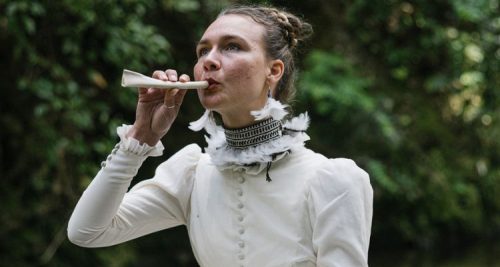
The taonga puoro on the project was a combination of pieces I had carved myself as well as ones that had been gifted to me by fellow practitioners and Tuakana of that space. I’ve been blessed and privileged to share some time around and/or wananga with Rob Thorne, Al Fraser, Te Kahureremoa, Ariana Tikao and Sam Palmer who are all incredible humans and practitioners of taonga puoro.
Some puoro were also shells from the beach and bones and stones from nature; The original producer and instrument maker! The act of making the taonga puoro added a richness and embodiment to the kaupapa of the whole project. The process of carving put me into a deeper connection with the forms, acts and practices of my ancestors, that, in a very tangible way connected me to them, helped me to understand what their world/perspectives may have been and to the same faces of nature that they interacted with.
Wood, harakeke, stone, sky, earth… I think it added an integrity and integration to this work that grounded me further into this concept of ‘KA MUA KA MURI’. The way we are still connected to all those that have gone before and those who will come after, like links in a chain. or stitches in a cloak.