Industry: The Story Behind MixMates
Industry: The Story Behind MixMates
Playlists are both the convenient digital-era version of lovingly shared mixtapes, and an efficient promotion mechanism for artists – and for the millions compiling them for any variety of other reasons. Still, as simple as playlists can be to compile on one streaming platform, none of us have the time or patience to repeat that process on a second, or third. It’s a problem for both music providers and consumers that now has a genius, user-friendly Kiwi solution – MixMates. Music fan, musician, problem solver and software innovator Jamie Baddeley backgrounds the fast-evolving MixMates story for NZM.

 The song between us
We’ve always gathered around music. Around fires, on marae, in pubs and living rooms, on Cuba Street with a busker pulling a crowd. Of all the technologies a culture builds, music is the oldest one for connecting people to each other. You don’t need words to share a song. You just need to be in earshot.
Streaming changed that, and not in the way the platforms tell you. The pitch was that we’d all have everything: every song, every artist, every back catalogue, on demand, for the price of a beer a week. That part is true. Each of us now walks around with a recorded music library that would have been the envy of the BBC 50 years ago. The catch is that we’re listening to it alone.
We’ve all got our own headphones on now. My partner is on Apple. My sister is on Tidal. My nephew bounces between Spotify and YouTube, depending on which one his school friends are using that month. We can each listen to anything. We can’t easily listen to the same thing.
In Aotearoa this matters more than it might in a bigger country. Our scenes are small and intimate. A song spreading through Wellington this week is doing it through people, not algorithms. It’s getting passed hand to hand, ear to ear, gig to flat to car stereo. When the platform link doesn’t open on a friend’s phone, that chain breaks. The song stops travelling.
I built MixMates because I got sick of that breaking. In MixMates you paste in a Spotify, Apple Music or Tidal link, and you get the same track back on every other platform. You can share it, and the person on the other end opens it on whatever they pay for. No more fiddling about searching the artist/ title on your phone. It just works.
That’s the small product. The bigger idea sits underneath it.
Streaming hasn’t only changed how we listen, it’s changed how artists get paid. Spotify pays artists the least, by some distance. Apple Music pays roughly twice what Spotify pays per stream. Tidal pays around three to four times. These figures move and the platforms don’t publish them, but the order of magnitude is well established. The twist, in Aotearoa, Spotify is also the most expensive of the three. $21 a month against $17 for Apple Music and Tidal. The easiest place to listen is the worst place to be heard from.
This is the moral economy of streaming, and most listeners are barely aware of it. They picked the service their friends were on, or the one bundled with their phone, and the choice felt neutral. It isn’t. Every play is a vote for what kind of industry the artists you love get to work in‐ side.
The catch is that, until recently, switching platforms also meant disconnecting from the people you share music with. You couldn’t listen on Tidal and stay in the loop with friends on Spotify. Each platform played in its own key, and switching keys meant the rest of the band couldn’t sing along. MixMates transposes between them. You can listen on the platform whose values match yours, and still share with the people whose taste you trust. The choice opens back up.
I’m not naive enough to think the platforms will agree to play in the same key. Spotify and Apple are larger than many countries’ GDPs, and they’ll be here longer than most of us will be working. We just need a way for the song to keep travelling between us.
MixMates is built in Wellington by a small team. We charge a modest subscription for the deeper features. We don’t sell user data, run ads, or train AI on your listening. We don’t track you across the internet. We make our money the way a hardware shop does, from people who want to pay for the tool. Whanaungatanga, gathering through connection, is something that everyone already understands without anyone explaining.
Beyond the link converter, we’ve shipped a few things that come from the same idea. Groups are private spaces where you and your friends drop tracks (and leave notes to each other) into a shared private history. The Listener apps, on iPhone and Android, hear what’s playing in the room, recognise the song, and add it to the group you choose. An embed widget lets a magazine, label or venue put a live MixMates group on their own website with one line of code.
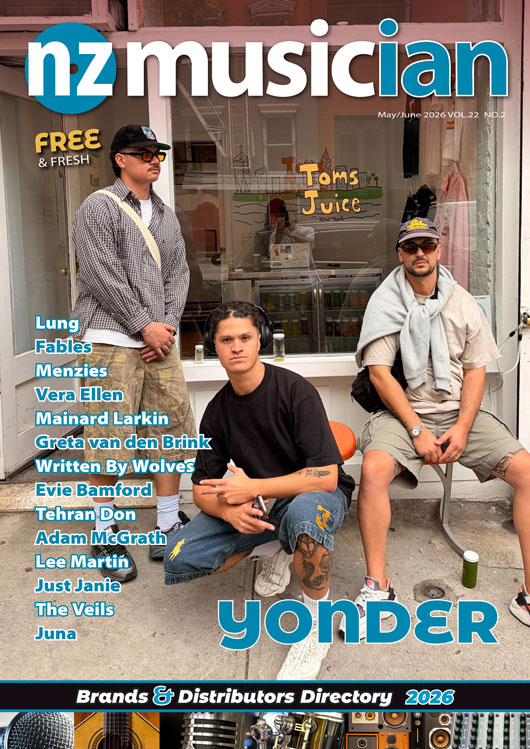
Click on the cover image above to access a playlist drawn from NZ Musician’s May/June 2026 issue contents. (Or the one below for a more internationally-flavoured MixMates intro playlist.)
 What I’d like any reader to take from any of the above is this:
We were gathering around music long before streaming, long before recording, long before the wax cylinder. The platforms took something that was always shared and made it private, quietly, without most of us noticing. The way back is not to abandon the platforms. It’s to find ways for the song to travel between them, so that the choice of where to listen can be made on values, not on which service your mates already pay for.
The easiest is not always the best. It rarely is, with anything that matters.
The app is at mixmat.es. That’s also where you’ll find the Listener for iPhone and Android. If you’re a publisher, an embed is a one-line job and we’d love you to try one.
Jamie Baddeley has been involved in technology for 30 years and enjoying music for longer than that. He has, in that order, chaired the ISP Association of NZ, InternetNZ, and Wellington Batucada. He’s apparently bad at saying no. MixMates is at mixmat.es