
Bic Runga: Return To Splendour
Bic Runga: Return To Splendour
Bic Runga may have spent time away from the stage spotlight, but she needs no introduction. Songs like Drive, Sway and Listening for the Weather are part of our collective consciousness, solidifying her as one of New Zealand’s most iconic artists and songwriters. Runga’s 2026 comeback album ‘Red Sunset’ sees her experimenting with synth sounds, while not forsaking her international career-defining acoustic roots. Nur Peach talked with her about the album’s genesis.
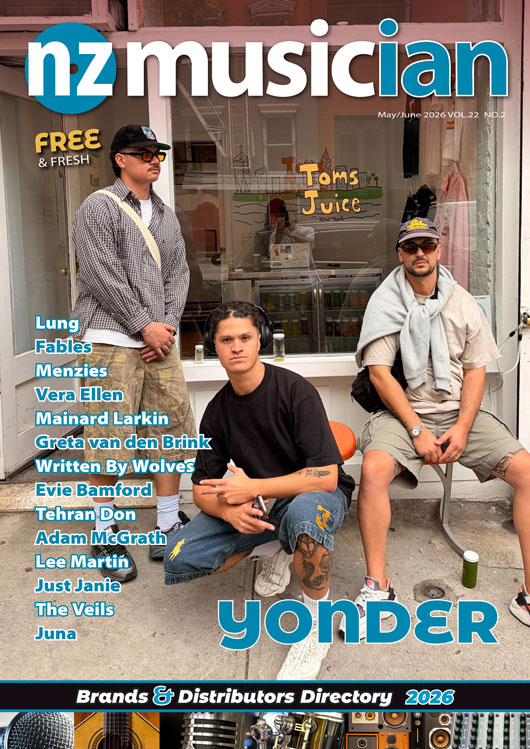
When NZ Musician first featured Bic Runga on the print magazine’s cover it was 1997, and only the beginning of her story. The sensitive singer-songwriter was 21 and yet to release her debut multi-platinum selling album ‘Drive’. Runga is now 49. Her last full-length release was a covers album, ‘Close Your Eyes’, in 2016, and we haven’t heard an original Bic Runga album since 2011’s ‘Belle.’
“The story I usually tell is that I just had a family,” she says. “My family life just got really busy and I didn’t have much time to focus on songwriting. I still like recording, and I still like playing live, and I still really love production, but it was just that songwriting part. You really need undivided concentration. It wasn’t so hard to make a covers album.
“But then I kept thinking of that Cypress Hill song I Ain’t Goin’ Out Like That, and I was like, ‘That’s not going to be my last record. I’m not going out with a covers album!’”
Since 2011 Runga has achieved some milestones. Prominent among those receiving a Legacy Award for her contributions to Kiwi music, and induction into the NZ Music Hall of Fame in 2016 – the youngest ever inductee. Runga reflects on that honour with a humble matter-of-factness.
“It’s just something that you can put in a bio. I think it was probably a bit premature, because that’s something you do at the end of someone’s career, when you think they’re finished. It’s a real honour, and it’s really nice, and I did achieve a lot when I was young – but I just didn’t feel like I was finished.”
She wasn’t, though the next release took time. Runga found the need to re-learn her instrument, studying vocal techniques with famed NZ opera soprano Dame Malvina Major.
“After I had my second child I couldn’t sing, and I didn’t know why. I didn’t realise how important core strength was to singing – nobody taught me how to sing. I met Malvina backstage at one of the music awards, and I shared with her my problem and just asked her to teach me some stuff.
“She was really generous with her knowledge. I went and visited her in Hamilton with Hayley Westenra, who was mentored by Dame Malvina. I just learned so much from both of them. The opera world is structured, sort of as an apprenticeship system, whereas in pop music, you just show up and wing it, so I needed to go back and learn that stuff.”
Runga obtained NZ On Air Project funding for a new album back in 2020. She cites lack of management as a key reason for the five year delay to its announced release.
“You can’t really do this without a manager. Even though I got funding in 2020 it still took a really long time to pull all the other pieces together. But since I’ve had management in the last two years, everything seems a bit more doable. There’s just so much that needs doing around the release of a record and August Avenue have done an amazing job.”
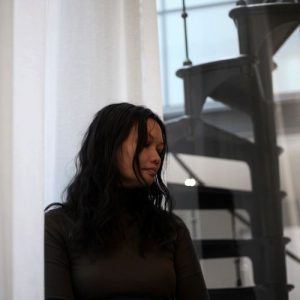 It was Runga’s husband, fellow Kiwi music icon Kody Nielson, who gave her the push to start recording while their family were on vacation in Paris.
“I lived there in my 20s, and after I had children I was just thinking, ‘Am I ever going to go back there, and are we ever going to see it as a family?’ With my son moving out, I thought we’d better quickly do it before he left home!
“When we were up there, Kody had brought all the gear and he just really made it happen. He miked up the piano that was there and just insisted that we get it done. And that was really helpful to give it a different vibe. Songs that I’d written at home in Auckland sounded better over there because I felt more free. I felt more confidence to deliver the song. It felt like the song wasn’t just some weird thing out of my imagination. We recorded all the piano there, and then we did drums and some vocals at home.”
‘Red Sunset’ was co-produced by the couple and mixed by Nielson. Some of the tracks take a more classic Runga approach, driven by subtle, sensitive band arrangements and clear, sweet-toned vocals. But some, including the title track and Paris in the Rain, branch into new, more electronic production-focused territory, with prominent synth sounds and effected vocals.
“I thought the right record to make would have been returning to that original ’90s sound that I had, reprising the first record’s sound. I thought that would be what you would come back with – so it’s almost like nothing’s changed.
“But then I just got bored, and if you’re bored, you’re just going to bore everyone else! You can’t fake excitement. I think it’s risky trying to make a sound like that when you’re known for being an acoustic singer-songwriter, but the bones of it are me and it’s either evolve or just repeat yourself.
“I think that’s maybe another reason this has taken so long. It’s like you either re-invent really slowly, or you do it in one night, like Miley Cyrus at the VMAs. I just started thinking that the key to re-inventing yourself is taking everything that you think is a negative about yourself and making it the big thing about you.”
Visuals for her album tracks also take a new approach. While Runga’s previous videos felt more slice-of-life and quintessentially Kiwi, the music video for Red Sunset and visuals for other songs have a surrealistic aesthetic, marked by vivid reds, purples and a sensual sophistication that again finds influence in Paris.
“When I lived in Paris I had a really great record label. The woman from my label was a really nice friend and supportive person, and she showed me around France, but she used to always say to me, ‘Bic, your music videos look like they’ve been made on a farm.’
“I told her that NZ wasn’t the Paris she was used to, and we have these weird, small budgets. But I’ve never really been happy with the video making process that much, it’s not something that I look forward to… In the end, we just made the videos at home. In fact, Kody made them.”
Given the slickly produced video for Red Sunset, it comes as a surprise to learn that Nielson had no prior videography experience.
“He just figured out how to do it. He’s a really creative man, and will go the distance to do everything and do it all by himself! Those are the people you should be watching out for, people that are agile enough to quickly upskill and just run with it. We made the Red Sunset video in a few days and again, he was just pushing me to do it. I was just like, ‘Okay, I’ll put some makeup on and show up to the garage…’”
The album does include reworked versions of some earlier songs. The oldest is the propulsive band-driven closer Home Run, which would’ve been perfectly at home on ‘Drive.’ It was originally written for the ‘Beautiful Collision’, Runga’s celebrated 2002 second album.
“It was something that I couldn’t finish around that time. I was so young, I’d barely been overseas before, and then I suddenly was living in New York and trying to make a second album – and that was just one of the things that didn’t make it. It was more of a straight up love song back in the day, but what a 25-year old would say is different from what a 49-year old would say. I rewrote the words, and now it’s about feeling like a loser, and just wishing that you could just get something right for once and for all.”
She’s not all afraid to acknowledge her artistic insecurities, and with the album all done Runga experienced nerves around the release process.
“What really hit home was that it wasn’t just the lack of time to write songs, but it was also having to face the industry again. Putting yourself out there takes a lot of resilience and nerve. I’ve come around to not being too worried about it. The bit I can control I’ve done, which is the music. It doesn’t really matter how it goes if I’m happy with the completed record, which I am.”
Several of her singles have reached the multi-million-plus Spotify play mark, with her 1997 all-time classic Sway closing in on a billion spins on that platform alone. Reflecting on her legacy, Runga is candid about how trying to live up to past successes has impacted her.
“Early success is a curse. I hadn’t really failed enough before I succeeded, so when I did end up failing, I didn’t know what to do. But I’ve been through so much now that whatever happens is okay.
“There’s not a mainstream popular culture in the same way that there used to be. There’s lots of massive niches and that’s cool, in a way. I just feel lucky that I’ve never had to do anything I really didn’t want to do. If you have enough financial stability to not have to do things for money, then you’re free to make creative choices.”
With the benefit of another $40,000 grant, from NZ On Air’s New Music Project Touring fund, Runga will take ‘Red Sunset’ on tour in 2026, playing a range of venues across Australasia. The backing band will include Nielson on drums, Cass Basil on bass and Carl Bennett on keyboards. She emphasises the importance of live show as an artform and source of income.
“What I would say to young NZ musicians is that people put too much on streaming. The real money is in touring and physical products. You won’t make a living out of streaming unless you’ve got Drake-esque numbers.
“I would focus on building the most impressive live show that you can create. The real strategy is to create something of so much value that every time someone comes and sees it, they leave a fan of yours. That’s more likely to happen in a live setting than online, when there’s so much in people’s feeds. Live shows are really important, but they take years of practice, so you’ve got to really hone that skill. I would even hone that skill before I went for funding or anything like that.”
Her NZ touring will culminate in a show with the NZ Symphony Orchestra at Wellington’s Michael Fowler Centre. Runga is looking forward to this show, having recently performed a similar one with the Auckland Philharmonic Orchestra.
“When I was growing up I listened to Shirley Bassey and The Carpenters, and Dionne Warwick and all these divas. I didn’t really know what age these women were, I think I sort of thought they were my mum’s age or something! I just always sort of thought that’s what you do eventually. You might have a pop career, and then eventually you’d be like an old diva. So that’s kind of where I was headed. Like, I just thought, ‘Well, I’m nearly 50, so why wouldn’t I do an orchestra show in a sequined dress?’”
She’s laughing, and recalls that she actually did an orchestra show 25 years ago with the Christchurch Symphony Orchestra. She had commissioned arrangements of her songs for that show, which were re-used with the APO.
“I loved the efficiency of it. A good arrangement is everything, it’s like an architectural plan. If the plan is not good it’s not going to work, but if it’s brilliant it will be solid. With the APO we only had two days to practice. I’ve never heard of that kind of efficiency! If it was my band show, I would literally start at a minimum four weeks out.”
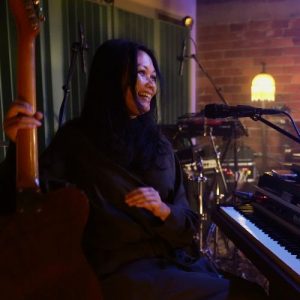
Another recent highlight involved performing as part of Neil Finn’s Infinity Sessions, the mid-winter music pick-me-up live-streaming series held at Roundhead Studios. Finn joined her on piano for much of her set, which included an early airing of some tracks from ‘Red Sunset’ along with several much-loved classics, and the famously talented pair reminiscing about earlier song collaborations.
 “That was wonderful. I’ve always had a lot of respect for Neil, and I’ve learnt a lot from him. He’s just such a pro and such a next level songwriter. I think we don’t have enough things like the Ed Sullivan Show anymore – where you’d cut through straight away in a night if you played it – and I think Neil was almost doing something akin to that, just trying to bring up all these artists. I actually discovered a lot of artists by watching his seven o’clock stream every night, and I thought that was brilliant.”
About to enter into her third term as artist representative on the APRA NZ board, Runga remains passionate about helping other Kiwi musicians.
“I’m really grateful to get voted on by the other songwriters and I’m really happy to do it because I just genuinely care about musicians in NZ. I had to learn so much about royalties and all the different rights. And also governance, which was something I never, ever thought I’d be interested in, but turns out, it’s really interesting.
“What we really need is more artists in governance, because I really have a big problem with music industry meetings that don’t have any musicians at the table. To me, that’s like lording over people like they’re children, and every musician I’ve ever met has been really clever, especially songwriters.
“To put yourself out there, to create something out of your feelings that you then share with someone else, I just think that’s alchemy. It’s almost like business people and so-called normal people think that we’re weird or something. But it’s not weird to me, it’s awesome.”