X-Factory: Marlon Williams – Aua Atu Rā
X-Factory: Marlon Williams – Aua Atu Rā
Marlon Williams continued his award-winning streak in 2025, taking home the APRA Silver Scroll Award for Aua Atu Rā, the lead single of his recent album ‘Te Whare Tīwekaweka’, co-written with Te Pononga Tamati-Elliffe, aka KOMMI.
Like the rest of the album, Aua Atu Rā is sung entirely in te reo, offering Williams the opportunity to engage with his Māori roots and express himself through the language of his ancestors. Williams says the song was inspired by the 1960s Māori showbands, and in this artistic expression he has beautifully merged musical and cultural traditions from here and abroad, while simultaneously bringing the past into the present.
Māori showbands were a musical melange in their own right, bringing together traditional waiata with the musical influences of show tunes, rhythm and blues, rock and roll, and Hawaiian music, and Williams has paid a faithful homage to this tradition while also showcasing his skills as a songwriter.
The beginning of the track immediately sets the vibe, with a lovely pedal steel guitar sliding into the opening chord on the first downbeat. Underneath is a jangly electric guitar, reminiscent of the ever-popular ‘Māori strum’, that underpins the entirety of the song.
The pedal steel guitar also continues throughout the track with light and tasteful fills and gentle chords before being brought into the spotlight at the closing section of the song. This subtle reference to Hawaiian music is just enough to act as a musical nod without falling into pastiche, and feels entirely at home within the showband homage.
The opening section is light on texture, prioritising Williams’ silky timbre that feels emblematic of the big band-era crooners and highlights the nostalgic feel of the track. The harmony and melody of the song also provide some historical gems. A stationary C6 chord sets the foundation of the song and provides a solid home base, yet early on we get a very unexpected B7 chord that immediately makes the song tack in a different direction, only to come straight back home again.
The second phrase repeats before concluding with an open dominant 7 chord that sets up the third phrase which introduces more non-diatonic harmony, including a lovely chromatic passing chord and secondary dominant before coming to rest back on the home chord. Note how Williams crafts a beautifully shaped melody that effortlessly weaves through these changes. The first two phrases move down in a stepwise direction, with contrary upward movement at the end of the bar, while the third phrase opens up the register and introduces more emotive leaps before coming to rest on the tonic note (Fig. 1).
The expanded harmonic palette and beautifully shaped melody, conjunct in the opening phrases and disjunct in the latter, is reminiscent of the early American showtunes crafted by the Tin Pan Alley songwriters – just one of the musical influences on the Māori showbands. Williams not only showcases his vocal and melodic abilities here but also clearly understands the tradition he is paying respect to.
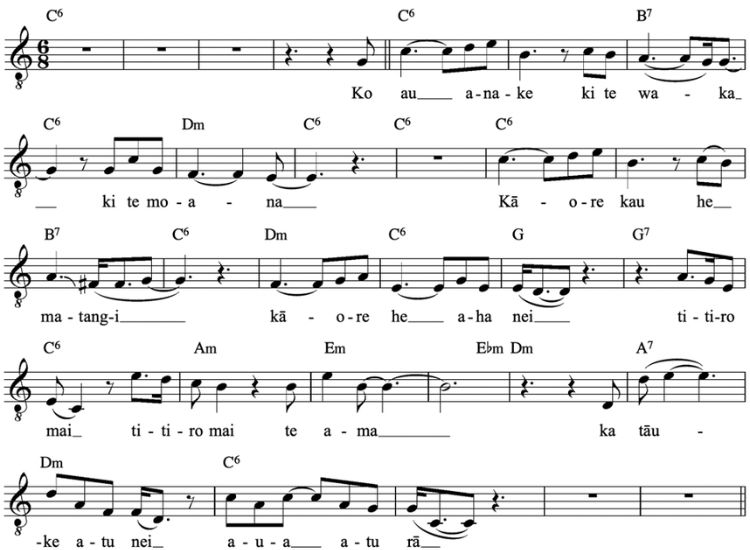
Fig. 1. A Section
The second A section largely repeats the musical material of the first, though the introduction of the backing vocals further ramps up the historical references. The block vocal harmonies that reinforce the cadential harmonic movement are straight out of the playbook of the doo-wop vocal groups popular in the 1950s and ’60s, another influence for Māori showbands. These vocal gestures not only further connect the song to that tradition, they’re also used to thicken the texture and create brief moments of tension and relaxation.
The B section introduces further non-diatonic harmony with a descending chromatic voice in the Dm chord, creating a line cliché into the G chord before resting on the tonic. The repetition then introduces a secondary dominant that, as before, does not resolve where expected. The melody is largely flat during this section but the added rhythmic emphasis and higher register creates a sense of drive and urgency that’s also captured by the backing vocals, which lean into punchy vowel sounds in lieu of long drawn out oohs and aahs (Fig. 2).
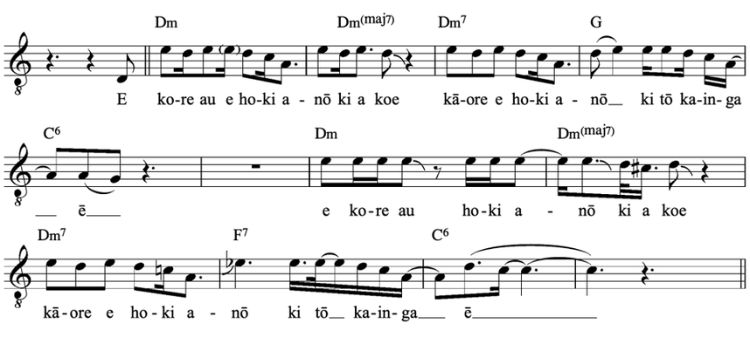
Fig. 2. B section
The final A section repeats the material from the previous ones, though it modulates up a whole step in a very direct way, with no preparation. This sudden and dramatic shift creates a strong push upwards, keeping the energy of the song moving while the texture slightly thins out, with soft sustained vowels in the backing vocals and delicate pedal steel guitar fills. As in the previous A section, the rich vocal harmonies are later used to punctuate the texture and build tension and release in a way that would make the Four Tops proud.
The form follows an AABA structure, rather than a standard verse chorus bridge structure. Though less common today, AABA was the standard formal structure for popular songs through the Tin Pan Alley era, as well as leaning into doo-wop, rock and roll, and much of the music that came out of Motown and the Brill Building. Alongside the natural timbre of the instruments, it gives the song a kind of timeless charm that avoids sounding retro for the sake of retro.
The songwriters have woven together a beautiful tapestry of different styles, cultures, and eras – creating a song that is both contemporary and timeless. The myriad musical influences that informed the Māori showbands are on full display here and they’ve drawn a musical connection through the showbands to the wider world beyond. The song and accompanying arrangement have a strong sense of national identity with rich cultural resonance, while remaining connected to broader styles and cultures beyond our shores.
People often say music is like a language, and it is indeed a universal one. Its ability to connect people across continents, cultures, and languages is one of its enduring strengths, and speaks directly to the interconnectedness between all people. Aua Atu Rā beautifully captures that spirit in a way that positively demonstrates how creative knowledge can flow back and forth, from one culture to another.
Jeff Wragg composes popular and classical music, and also composes for film, television and theatre. He is also an educator and has held teaching positions at MAINZ, SIT and Victoria University. He can be contacted at www.jeffwragg.com