

Dillastrate: Building On The Aroha
Dillastrate: Building On The Aroha
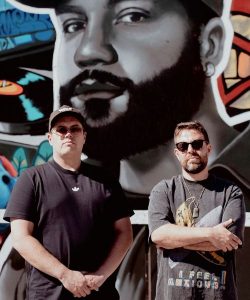
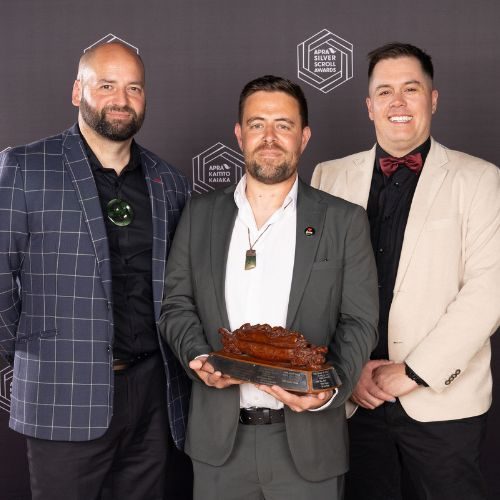
Ōtautahi duo Dillastrate are known for their uplifting live shows and music traversing electronic genres, soul, pop, hip hop and more, taking audiences into dance-fuelled celebrations. Having built a reputation as a touring act Henare Kaa and Tim Driver have more latterly shifted focus towards recording, and championing the use of te reo Māori in contemporary music. Finalists alongside Marlon Williams and MĀ, the band’s anthemic Kei Whati Te Marama won the APRA Maioha Award, which celebrates outstanding waiata written in te reo Māori, at the 2025 Silver Scroll Awards. Following up on that success, in February Dillastrate released an EP titled ‘We Built This World With Aroha’. Richard Thorne talked with them.
Asked about the growth curve of Dillastrate over the band’s near decade-long lifespan, drummer/vocalist Henare ‘H’ Kaa and his synth-surrounded music partner Tim Driver agree it’s been a consistently upward trajectory, aside from the interruption of Covid, which had an obvious impact on what is primarily a live two-piece act.
“Tim and I come from a session background. We had played for multiple bands, toured all around the country and stuff, then finally we decided it was going to be logistically easier if we just did it by ourselves. And that’s worked so well,” Kaa backgrounds.
“We started off as a band with the idea of cold messaging a bunch of venues around NZ. The three of us – the third member is Jamie Thomson – he does all the sound and the production side of Dillastrate. We just decided we’d all chip in money to go and play a show in Wellington in 2017, trying to be serious! And as it went, every year it just keeps getting bigger and bigger, to the point last year we won the Maioha Award at the Silver Scrolls!
“Yeah, it’s just been a gi-normous fun ride – and we don’t know how we’re going to top the Scrolls, but it’s only January…”
It was the performing handbrake of Covid that led to a key breakthrough that reshaped their whole Dillastrate kaupapa.
“We had a really good thing going before Covid hit in 2020, and we lost a lot with that,” Kaa continues. “Before then we didn’t jump on the bandwagon of what was happening in the content world, because we were such a live presence, that’s what we specialised in.
“Deciding to go down the te ao Māori direction [post Covid] just completely changed the game for us. It was kind of a risk because of the listenership, you know, the majority of the listeners are going to be listening to reo Pakeha songs. But streaming wasn’t the big thing for us. It was everything else that we kind of leveraged to gain off being one of the only Māori acts in Te Waipounamu, being kind of like the outsiders.
“We leaned into the fact that, geographically, we weren’t as favoured as some others. But that led us to be invited to be part of the Waiata Anthems programme in 2024. And then last year, landing the two songs for the cricket, [Kei Whati Te Marama and Ko Tātou Te Ahi have both been used in global broadcasting by NZ Cricket], was huge for us.
“I think that was the combination of really digging into what people would see as the cons of what we were trying to do, you know being a Māori act from the south, so we’ve kind of doubled down on everything. We doubled down on content. We’ve doubled down on releases. We’re not releasing music around Māori holidays or milestones, we’re doing it all the time. The te ao Māori thing is just such an awesome and rewarding avenue, and I think that’s our greatest milestone, I guess you could say.”
“Yeah, I would agree with that,” Driver takes over. “Because it’s not only in terms of career trajectory, in what you would normally classify as success… For us personally it’s been a really incredible journey, really delving into that kaupapa Māori approach to writing waiata.
“It is very different from anything that I’ve ever done before. I am pakeha, I’m tangata Tiriti, so being in that space has been a really enriching thing for myself personally. I’ve learned a lot of reo Māori as a result, but I think it’s really enhanced our songwriting and our approach to songwriting.”
Their five-track 2026 EP ‘We Built This World With Aroha’ EP includes two versions of the waiata So In Love, the first largely reo Māori, the second in English. Driver enthuses about the process and pleasure of working with their mātanga reo Hemi Hoskins on that.
“So effectively the two versions express the same sentiment, but when we’ve looked at the translation we’ve made sure that everything goes through that te ao Māori lens. So not just a literal kind of approach, you’re really trying to convey it so that it’s meaningful through a Māori lens.
“For me personally, that’s unlocked a whole other world, and I feel like I’ve been greatly enriched, just as a human being as a result. So both musically and in terms of, you know, the trappings of success, it’s been a really incredible move for us.”
Kei Whati Te Marama was the stirringly anthemic highlight of Dillastrate’s 2024 album, ‘Ngā Pounamu’, which involved collaborations with multiple producers. For this project they used just the one producer, Rory Noble, while the songs were written collaboratively with others.
“The idea was having these artists also join in on the creation of it,” Kaa describes. “The kaupapa behind ‘We Built This World With Aroha’ is around everything that was happening at the time, and everything that’s happening now… as much as it seems like the world’s turned into a big pile of poos, the idea of this is to show that the te ao Māori view is all about love.
“Every story on the EP is about love. Feel That Aio is about feeling that whole, encompassing feeling of aroha. Built This World With Aroha is like, at the end of the day love will prevail, regardless of what happens in the world. So In Love is that really sentimental point of aroha. And the last song is called Wairua, which is the spirit in behind that pushes all of that, kaupapa, forward into the future.”
Dillastrate received $50k funding for the recording project from Te Māngai Pāho. While titled in English, ‘We Built This World With Aroha’ is close to being a 50/50 bilingual release.
 Mostly their songwriting starts with a melody, and a lot of “da de does and na naa nas” overlaid for demo purposes as Kaa explains.
“Then, when we get together with our matanga, we look at the phonetics of the wording and the phrasing, because obviously you want to find a sort of middle ground with that, with making sure that a melody line isn’t compromised by the flowing of reo Māori, and vice versa, you’ve got to make sure that you honour the tikanga.
“I think between the three of us we’ve really got a cool way of composing our waiata. We’re trying to push the boundaries. I guess it’s kind of what Rob Ruha does with the way he’s trying to compose, adding more slang and more the modern day kiwaha I guess, to his lyrics.
“I think our whole kaupapa is we’re trying to change the perspective of te ao Māori on a global level, you know, where the world’s perception is quite outdated. We want to be part of the fleet that is preparing te reo Māori for the future, in order to have this different perspective.
“I’d love for the world to look at us like they look at K-pop, like they look at reggae, like they look at cultural music from around the world. I want them to look at us and go, ‘Yeah. This is what Maori music is.’ It’s not just kapa haka or Poi E.”
The EP was recorded in just two and a half days at Roundhead Studios, with Noble producing and Dillastrate’s third-member, sound guy Jamie Thomson on bass.
“He’s an incredible bass player,” says Kaa. “We also get him there so when we play live he’s heard it from the ground up, so a very Shapeshifter/Tiki Taane-type buzz. But we also bring him because he’s the vibe. He makes those days go so fast because he’s probably the funniest human on Earth.”
The speed of recording belies the detail and balance achieved, especially considering the importance for each track to work performed live by just two musicians. Indeed the songs intriguingly somehow carry a sense of being recorded on-stage.
“That’s a conscious thing, it’s a discussion Rory and us have,” Kaa confirms smiling. We’re like, ‘This is the sonics that we want to go with.’ Also, because we have the ability to track fast, we can make those decisions on the go. Like if we reckon this song’s going to sound huge live, then we need to give it that live tinge.”
“And a bit of that comes down to just our sensibilities naturally as well, right?” Driver adds. “We’ve been live musicians, predominantly, for a very long time [both are now close to 40], and I think a lot of instincts that we have just for playing music bleeds into the studio. So I think there’s an amount of that baked in, and then a certain amount that’s a conscious decision. Again, it’s about serving the song. Is the song lending itself to that? What does the song want to become? Does it want more of a live sound?
“It’s knowing what’s important, right? And from every group we’ve played with, we’ve been able to see what’s worked and what hasn’t worked, and I think that was part of the design of Dillastrate from the ground up, you know? All three of us have had extensive experience prior to this band, so we’re able to forge that into the working model of how we actually operate.”
“We’re very lucky with how we sessioned before Dillastrate,” Kaa confirms. “It’s meant we understand the things to worry about and not to worry about. We’re able to have as much fun as we want in the studio, because of how we’re able to troubleshoot everything beforehand, and after.”
On stage he sings, engages the audience and plays drums, while Driver handles all other instrumental responsibilities, with the aid of some backing tracks.
“So, I’ve got these two hands, very important!” he laughs. “I’m running a Moog Sub Phatty synth that handles the bass responsibilities, and a Nord Stage 2 at the moment, anything with the patches I need works fine. Also I’m running one of the Yamaha CS-20 remake analog synths.
“So it’s the chords in the right hand, the bass in the left hand, the lead lines in the synth. And beyond that I’m handling the pre-recorded instrumental kind of loopy, tracky stuff.
“We did live looping for the longest time, and it could get quite stressful because I was handling these three instruments, and then had a set of loops on an APC40. And beyond that, I’m queuing H for when we’re going to go to these different sections, which was stressful for him, not knowing when he should start singing!”
“We realised after a while that it had become kind of pointless, because we had the same arrangements that we were doing live. We were effectively doing things in the same order, and the live looping element wasn’t really being used. So we were just causing ourselves more stress, unnecessarily. So we’re controlling the majority of the instrumentation between the two of us, all that pre-record is doing is sort of enhancements, or things that we couldn’t possibly do with two people.”
By contrast Kaa’s drum kit is all acoustic.
“Technology and me not the best of friends,” he smiles. “I seem to have tremendous bad luck with electronics. I got to play and conduct the orchestra at one thing when the SPD just decided to turn itself off, so I kind of don’t trust that stuff! I think we’ve learned too that, because I’m a drummer by trade, I might as well just play the analogs and sing. And because we have the power to use tracks, I also do the hype, so I’m able to get off the drums…”
 “I like using the analog kit as well, because it means that we’ve got greater control of the dynamic,” Driver adds. “We had toyed with the idea of using pads or, you know, SPD-type setup for a while, but you just can’t get that same dynamic. You can’t control the set in the same way that you would if you just have the pads there. And we are a touring machine, we’ve done so many tours of NZ at this point, so we’re very nimble.”
Driver notes that ‘serving the song’ has been a consistent kaupapa for the duo over their career.
“That was a line from Aaron Tokona, actually, our mentor,” Kaa takes over. “I remember I completely ballsed up a massive gig, and I made a joke about it, but really it was because I was not prepared. The environment got the better of me – didn’t realise 4000 people could do that to me, and I shat the bed!
“And his reply was, ‘Don’t make this about yourself. You have the ability to serve music, therefore you should serve music, and that is the bottom line.’ Yeah, and that’s kind of our mantra, isn’t it bro?”
Having first worked together in AHoriBuzz, the Dillastrate pair have consistently acknowledged the late Aaron Tokona as a major influence, and honoured his memory again with their 2025 Maioha Award win. “Aaron enabled the genesis of Dillastrate. We miss him dearly and want to dedicate this tohu to him,” Kaa told the Christchurch Silver Scroll Award audience.