Casual Healing: Elements of Wellbeing
Casual Healing: Elements of Wellbeing
Nikau Te Huki, the Wellington-based indigenous songwriter and multi-instrumentalist behind Casual Healing, has spent the past year crafting and releasing an eclectic, genre-bending body of work bound together with a message of connection with the natural elements. Te Huki chats with Dasha Koryagina about the project and the forces that drive him.
A new-age charmer on a mission to better people’s lives and reconnect them with nature, during 2025 Casual Healing has released a series of four EPs inspired by the elements – ‘Ahi’ (fire), ‘Hau’ (air), ‘Wai’ (water), and ‘One’ (earth).
The series charts Nikau Te Huki’s personal journey through the year – the ups and downs as seen through the lens of elemental forces – musically blending a variety of genres, from RnB and reggae, to roots and hip hop. Each EP has its own distinct vibe, while collectively they invite listeners to embrace a more balanced and connected way of living. For Nikau, the work of Casual Healing begins with himself.
“Sometimes people ask me, who am I trying to heal? I’m just on a journey to heal myself. All the music I make is like a journal, and it appears that when I share my journal, there’s people out there who it resonates with. And maybe it gives a bit of perspective for their healing journey as well.”
And what’s he healing from? Historically – thousands of years of generational trauma. More immediately – the disease of modern life.
“I’m healing from the impact that my life has had on my mind. Media, food, porn, doom scrolling for years, and just realising the long-term psychological effects that modern-day living has on the mind. And realising when I’m trying to meditate and quiet my mind, how noisy it is in there.”
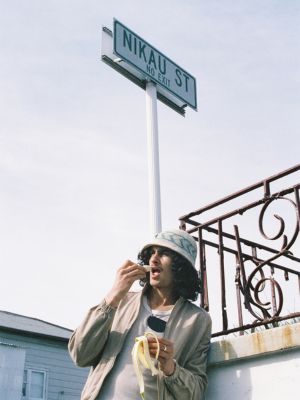 Nikau doesn’t see himself as a preacher, but he is committed to using his talents to encourage wellbeing. His music focuses on messages of aroha, family, connection, and spirituality, with the goal of helping people be as healthy and whole as they can. This mission, he says, reflects manaakitanga, the practice of lifting people up. For Nikau, the biggest enemy is division.
“We’re divided on many levels. Physically, we all live in boxes with fences around us, and socially, our main form of conversation is through an electronic device, so we lose the nuance of face-to-face connection.
“Not only are we disconnected from each other, but we’re also disconnected from the very forces that sustain life. We eat what the supermarkets put on the shelves, but a lot of that has no sunlight or rain or mauri left in it, and it all adds up to us being unhealthy,” he says.
“Our health is not just how much Panadol we have in the medicine cabinet. It’s about how many good friends do we have in our lives who can be honest with us? How connected am I to the food that I eat? Am I getting enough sunlight in my eyes every day? And on a spiritual level, where does my soul reside, and where did I come from?”
Growing up with the unusual blend of Māori and Italian heritage, Nikau had a deep appreciation for culture instilled in him by his grandmother.
“My nona – my dad’s mum – is Italian,” he explains. “Every Christmas, all the cousins would gather at her house, and a key part of the celebrations was performing kapa haka. Even though nona was full-blooded Italian, she married a Māori man, and she would have Māori spoken in the household – and really encouraged it, whereas my Māori koro was quite closed off to it because of how he was raised. So my white-as Italian nona was like the Māori-est Italian in history!”
Nikau attended Hato Paora College in Feilding, a Māori boys’ Catholic boarding school where rugby was compulsory – a tradition he found strange. After a fall on the field he found himself a target.
“Every time the bullies were after me, I’d just run to the chapel because they couldn’t bully me in the chapel, and I just played the piano. That was where my passion for music really was born,” he smiles.
The rigid school system, which he felt prized academia over creativity, eventually pushed him out.
“I got expelled because I wrote a poem that triggered the principal. It was about how the schooling system only encourages a few specific ways of thinking. There was no art available for us to study, and a lot of us indigenous folk seem to struggle with science and mathematics and geography. I was sad that a lot of my bros were failing when they were actually really intelligent, creative people, so I wrote a poem about it, and I said it at Chapel in front of the whole school.”
Nikau left school that same morning, and went into a music degree, trotting the creative path since. The idea for Casual Healing’s elemental series came unexpectedly while Nikau was eating ice cream in bed, as a 21-year-old father, watching Avatar: The Last Airbender.
“Nature’s just awesome. Everything we have ever needed to survive is right outside, and it all plays a really important role. We couldn’t have water without fire and we couldn’t have trees without air. I’m a Libra, which is all about the philosophy of balance, so I wanted to put together a series of EPs that balanced each other out.
“Also, I wanted to create a collection that displayed the many aspects of who I am, because I love hip hop, but I love reggae, and I love folk and everything in-between. I wanted to make this eclectic series so that I could just play and create whatever came to my mind.”
Each EP carries its own distinct vibe, shaped not only by musical experimentation but also by the stage of life Nikau was in while creating it. Released in April ‘AHI’ literally introduced the four-elemental EPs. An intimate almost conversational approach to the music is set. Grooving closer track Hypersensitive, featuring MĀ, is a stand out.
“When I made ‘AHI’, I was playing with this epic live band, and my career as a musician was really starting to ignite. I had these beautiful children, an amazing partner, and things were just burning.”
In contrast, ‘HAU’ represents a period of change and reflection, the lyrics more introspective and music less settled. Dub and reggae rhythms are prevalent, but the mood is sombre.
“I stumbled from the top of that mountain into a valley, and the wind of change extinguished the flames of ‘Ahi’. That gave me some darkness, and I had to look at some things the wind revealed to me, and I saw room for evolution in my life.”
By the time he reached ‘Wai’, released in September, Nikau had found a sense of resolution and peace. Karen Hunter voices the EP’s title track, and there’s a strong sense of spirituality elsewhere. Moving Together provides an uptempo highlight.
“I sorted my stuff out, I was at peace with myself, and I was at peace with people in my life that I needed to find peace with, and ‘Wai’ just flowed through me. I wrote that whole album in a couple of weeks, and it’s dedicated to the generations of women in my life who make me strong – my aunties, mum, partner, and daughter.”
The final EP in the series, ‘One’ (pronounced Ō-ne) rounds off the series with the lasting impression Nikau wants to leave.
“Finishing with earth, the foundation of life and all the elements, is my way of putting that foundation in the spotlight,” he explains. “I recorded it with an 11-piece band at Massey Studios, and each of the tracks is one take with no redubs, overdubs, or re-recording. It’s all live music in the moment, no edits. As earthy as it gets!”
Taonga puoro, some of which Nikau has crafted himself, play a central role in the series, drawing on ancestral mana to imbue the music with power.
“When we do the things that our ancestors used to do, it’s like they hear you and they come,” Nikau explains. “And having them with you is like spiritual armour, because they’re always watching and waiting for you to invite them.”
Te reo similarly threads through the EPs.
“It’s a beautiful language where you can tell a big story with just a few words. Our Māori orators of ancient times were very poetic – my reo is far from reaching its poetic potential, but I love to give it a go. I love the way it sounds, and I love that I can connect with it.”
His four EP series features an extensive list of collaborators, including Dub Princess, Kenzie from Welly, the Hongi Slicker, MĀ, Ari Leason, and Matiu Te Huki. Bringing many voices into the project was about more than just featuring the artists themselves Nikau says, it was about bringing in their ancestors, families, and friends, weaving all that mana into the music.
“Our word for chief is rangatira. Ranga means to weave, and tira means the tribe. So a chief’s ‘chiefliness’ is determined by their ability to weave people together, creating community. So, yeah, just practising my rangatiratanga,” he laughs.
The first three EPs were self-produced in Nikau’s home studio he calls Te Whare Chur, in Pōneke. “It’s just a bougie garage, really! That’s where I’ve recorded all of my stuff since I started.”
Producing his own music has allowed a level of control over his sound that would be difficult to achieve in a commercial studio.
“I’m a nerd when it comes to production. Every microphone, every preamp, every instrument has its own sound. As a producer you’re wondering how do all those sounds relate, and then how does my voice sound on top of all of that? You’re a painter, and there’s a canvas, and you have all your colours. Being able to produce my own stuff has given me the time to really honour the compositions and curate each track – to be a perfectionist if I want to be a perfectionist. If I was paying for studio time I’d never be able to get that finesse.”
Casual Healing’s creativity has been supported by Te Māngai Pāho plus other grants from NZ On Air. Beyond that it’s been a collective community effort.
“I’m not really making money from my music yet,” Nikau explains. “These first few years of my career have been super voluntary – and not just from me, but from a lot of the musicians that I’ve worked with – everyone’s supported me in some way. And that’s how we’ve made it work, the community getting behind it. Because it’s not just ego music or vanity music, there’s a bigger picture than just chasing stardom.”
Iwi radio has also strongly supported of Casual Healing.
“I’ve had heaps of interviews with Te Upoko o Te Ika, our local iwi radio in Wellington. They’ve helped me reach a bunch of new listeners, and reaching that more Māori audience is a real treasure for me,” he says.
After journeying through the entirety of the series, Nikau hopes listeners experience their own connection to the elements. “I hope they feel the fire, the wind and the water themselves… and I hope they buy the double-disc vinyl collection of the four EPs,” he laughs.
In 2026, Nikau is taking the music to the people, embarking on a year of touring done in a way that nourishes the community.
“Basically, I’m playing 30 shows across the country. Travelling with my own PA system, playing in community centers, town halls, people’s lounges, surf lifesaver clubs – any space that can facilitate a potluck, that can be alcohol-free and all-ages friendly.”
From a chapel piano, to a garage studio, to the world, Casual Healing will be quietly making its way around the motu.