Aridni Orca: Tales of Fantasy & Imagination
Aridni Orca: Tales of Fantasy & Imagination
You may remember Indira Force as the singer from Christchurch trip-hop group Doprah, or from her ethereally experimental solo project Indi. 2025 sees the Titirangi-raised, these days London-based songwriter, composer and producer entering a new era with her rebranding as Aridni Orca. This new artist’s first album, ‘The Bell, The Swan and The Golden Thread,’ takes the musical experimentation already evident in her work as Indi even further. Nur Peach spoke with her.
Indira Force last spoke to NZ Musician in 2017. That was the year she released ‘Precipice,’ her debut album under the name Indi. Since then, she has lived in Berlin, Tāmaki Makaurau, and since 2023 in London. ‘The Bell, The Swan and The Golden Thread’ slowly took shape over that time period. Life and work have delayed release of the music for several years.
“I got a job as a full time music producer, so all my time was spent doing that. You just kind of get all the bits of time you can over the years. I wish this album had been able to come out sooner, but time just keeps passing, so I’m glad to be doing it now!”
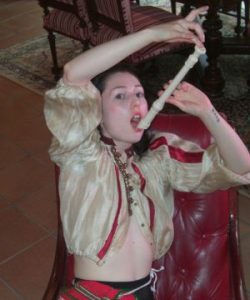 Approaching the release, Indira realised a name change was in order, for reasons both practical and personal.
“I started Aridni Orca because the Indi stuff felt so different to what I’m doing now. I feel like I’ve shifted so much as a person, but also my Spotify was flooded with other artists who weren’t me! Indi was a really common name. I was always on Spotify for Artists going, ‘No, this is not my song. No, this is not my song.’ I realised that I just have to change it to something that no one else has, because otherwise it’s getting swallowed.”
The Aridni part is easily decoded, it’s Indira spelled backwards.
“I was talking to someone about how when I was little, we had reverse name day, and everyone had to be called by their names backwards. I remember being like, ‘Oh yeah, my one was Aridni. It was so weird, it didn’t really sound like a proper name.’ And then I was like, ‘Wait, maybe that could be a cool artist name!’”
And Orca? That comes from her affinity with the mammals, and a core childhood memory. Indira lights up as she describes it.
“I was at school camp. My friend Samantha and I were going for a run along the beach really early in the morning. We just saw this pod of orca whales! There were babies and there were two really big ones. They came right up, because the water was deep quite close to the shore, and we were running, and they were swimming alongside us. We just ran for as long as we could with these orca whales, and they were so much bigger than I ever thought they would be. The fins alone were so massive! I often message Samantha, who I barely speak to anymore, and say, ‘Did that really happen?’ And she’ll say, ‘No no, that really happened, and it was amazing!’”
Speaking of names, the whimsical title, ‘The Bell, The Swan and The Golden Thread’ came early in the production process.
“I love old fairy tales and storybooks, and the initial idea for the album was that it was going to feel like a storybook, and that each song was going to be a chapter. I failed at that for the most part, because what came out came out. But I did keep the name, because it still feels kind of delicious to have a simplistic kind of name that feels like you know what you’re going into and then it is this quite messy, abrasive, strange collection of songs! But also for me, all of the objects, the bell, the swan and the golden thread, have a lot of personal significance.”
The album was produced almost entirely in Indira’s bedrooms, across the three different cities she lived in over the period. She also mixed it herself.
“I was originally working with someone else to mix it, but they were just never coming out quite like I had hoped, and they were taking a long time, and I was feeling really blocked by that. So I started mixing myself, and it was just so much easier. I’m not like a professional mixing engineer, but I know what I want to hear in my music, and I had been telling myself for years that I needed to always use a professional mixing engineer instead of just trying it out myself. It feels like a strangely empowering thing to do to mix my own album. It’s not as slick maybe as it could be, but I feel like it sounds more me.”
Some additional production was done in Auckland at Roundhead Studios, where the harp parts were recorded by harpist Amy Yoon.
“I learned harp while I was making this album. I just kept writing these MIDI harp lines and being like, ‘I think I need to learn harp.’ I’ve always wanted to play harp anyway, so I started taking classical harp lessons. But at the time, I was never good enough to actually play the harp parts that I’d written. So I ended up going to Roundhead Studios and recording Amy, who was actually my harp teacher at the time. I got her to bring in her big classical harp, and we did a whole session. I did play the harp on Hyperlove, which is the last song on the album, and record it.”
In March this year she released an extraordinary and typically theatrical video for Crushed, made with the help of NZ On Air New Music Single funding dating back to May 2021. Live footage filmed by Frances Carter that includes her playing harp, is blended with animation, editing and direction by Ella Chau.
Another Roundhead session involved recording the bell-like piano sound in Will o’ the Wisps, which was achieved in an unusual way.
“I put salt and paper sachets and teaspoons into a piano to do that sound! There’s a song by Aphex Twin called Jynweythek, which is, like, very plinkity. It’s got a lot of strange attack. I don’t think it is prepared piano, but I was kind of going for that kind of sound.”
The willingness to experiment displayed in this anecdote is evident across the sonically unusual album. At once ethereal and abrasive, ‘The Bell, The Swan and The Golden Thread’ is nothing if not unconventional.
“There’s just no point in writing stuff if it doesn’t make you feel,” Indira says candidly. “I guess that’s what everyone’s trying to do, communicate clearly some kind of intangible feeling, and I think the production is part of that articulation process.
“I don’t think it’s like you sit down and go, ‘I’m going to write a song about this.’ It’s more like your brain is this strange machine that turns out this strange dream sequence of emotions. When I listen to this record now, I go, ‘Wow, I was really escaping a lot into these songs.’ A lot of it is escaping into my childhood, or into different pockets of my fantasy imagination.”