

Antonio Mercuri: Experiencing Oasis in New York
Antonio Mercuri: Experiencing Oasis in New York
As Programme Manager of Southern Institute of Technology’s (SIT) contemporary music and audio production courses, Antonio Mercuri took the opportunity of 2025’s record-shattering Oasis reunion gigs to develop some first-hand content and industry observations for the school’s 2026 contextual-studies paper. He shares a little of his New York concert ‘research’ experience with NZM.
In a current industry model that is mostly saturated by AI musical artifacts, algorithms writing melodies, and a landscape where perfection is automated, it was a matter of time before some form of musical renaissance cut its way back through the mainstream. However, I don’t think anyone was prepared for who or what it was…
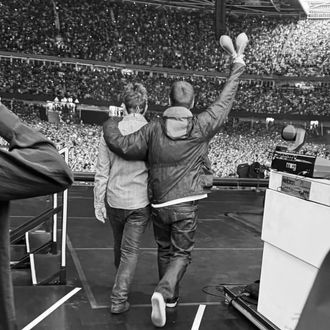 Turns out it was a cultural flashback to a different era, with a couple of banter-swaggering Mancunians singing simple songs with attitude, nostalgia, and a tambourine. I also don’t think anyone anticipated how colossal the reaction would be. It seemed to completely hijack the cultural conversation almost overnight.
In case you were born under a rock, the band is Oasis, formed in Manchester in 1991, fronted by brothers Liam and Noel Gallagher. The band’s sound was unique and melodic, following in the wake of their Manchester-scene predecessors such as The Stone Roses and The Smiths. The debut of their first album ‘Definitely Maybe’ in 1994, shortly followed by ‘(What’s the Story) Morning Glory?’ in ’95, sparked a new wave of British indie music, later referred to as Britpop. From these two albums came 11 singles, including a few casual national anthems, as well as fan-favoured B-sides that developed their own life force.
Fast-forward to 2025. Somehow, in and amongst a mild recession, a cost-of-living crisis, and a brooding social and political divide, Oasis is – in real time – pulling off one of the most successful and fascinating reunion tours of our contemporary music-history books. When writing this we are yet to see the figures, but what we know so far is that every show is sold out, tickets are among the highest-priced ever, with over 1.5 million sold for the UK tour alone (helping bolster the UK economy by over $1.1 billion), and they still have three continents left to play. They have also boosted the international sales of Adidas and Guinness considerably (which I can get behind).
Ultimately, though, what is really fascinating is the why. Why this band? Why now? What is it about these four-chord songs that is making some fans leverage their mortgages to follow them gig to gig? To spend days waiting online to buy extortionately priced tickets? As a fan and a tertiary-level music teacher, I couldn’t think of a better opportunity for ‘professional development’ than witnessing the phenomenon myself. However, the UK shows were already sold out (within days), so New York it had to be!
I must say, I’m lucky enough to have one of my best friends and bandmates living there, with a place to stay. So with some subtle encouragement from him to commit, “Bro, it’s the f@#king Gallaghers” – and convincing my school that my leave was in the best interest of SIT’s Music and Audio Department – I secured my flights, put Oasis on repeat, and now all that is left is a bucket hat, a parka, some jetlag, and most likely an impending hangover. Time to invest in Guinness stocks.
Thus far, Oasis’s reunion has ravaged through the UK and Ireland with immense success and publicity – not only from the general fanfare, but from a well of celebrities, footballers, and musicians all getting behind it and sharing online testimonials. The reviews are collectively massive: emotive and exciting. You know something is up when videos of Paul McCartney emerge of him singing along and filming the gig from his VIP box at Wembley.
This wasn’t all just an explicit, hedonistic fan-boy trip. The goal of the trip wasn’t just to raise Guinness stocks, it was also to impart some general industry observations for our contextual-studies paper – a fancy way of studying music movements in their social contexts.
The New York gig was at MetLife Stadium in New Jersey, just on the other side of the Hudson River, an 80k-capacity arena, roughly the size of Jupiter. After ample pre-game activities throughout Manhattan, including a loaded subway ride under the riverside we made it. (Note: Did anyone tell you that you can legally drink on the trains if it’s kept in a paper bag? I’ve never seen more bucket hats or paper bags in my life than on that train!)
We managed to get as close as our ticket value would allow, which was pretty good considering the difference of five metres to the front section was about a $500 difference.
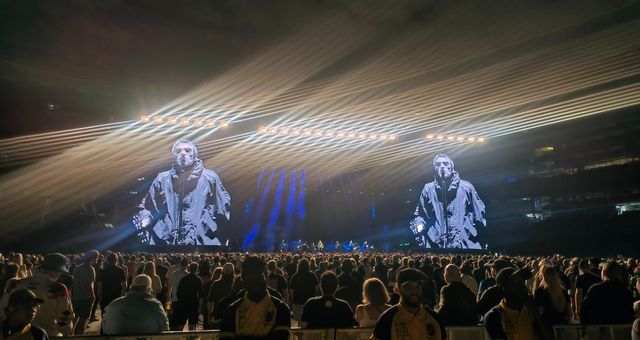 My first interesting observation was of an extremely diverse audience. The stereotype of the 40+ year-old nostalgia-burdened man in a tracksuit was evident, but surprisingly so was the high number of young Oasis fans. In our semi-circle we made friends with an 18-year-old pilot from Nashville named Jake, who at 5’4″ had pushed his way through a crowd to get as close as possible and unapologetically scream every word to every song. In front of us were three early-20s females who had flown over from London, having already watched two Wembley shows and another in Dublin.
Now, there are a multitude of credible Oasis gig reviews available from people with far more notoriety than a tertiary-level music teacher from Invercargill, so I’m not going to spend time attempting to review it all. I won’t talk you through the tracks, the continuous hit after hit, Noel’s acoustic segment, the fireworks, etc. But I will point out that 80% of the tunes played that night were written by Noel within an 18-month period (from Definitely Maybe to What’s the Story?). Whatever wavelength that dude was floating on during that time was some divine freak-out.
Ultimately, the power of those songs proved immense – it is undeniable. They float like they’ve always been there, like they were already living. Not rehearsed, more just given to us. That really is the power of well-crafted songs: they become ours, given to us by the divine and lived through the people.
This feeling couldn’t be emphasised better than by Noel Gallagher himself. “It’s the people that make the songs great, not the writer… Those songs became great not because of anything I did. I only wrote them.”
Oasis has since slowly released live tracks from these gigs on Spotify etc. verifying this is the band sounding better than ever – they sound like a mountain. Liam’s voice is pristine, and the brothers’ harmonies are exactly that. Listen to Noel sing Little by Little and literally hear an audience sing in unity alongside him.
So is it just the songs, the catchy melodies and roundabout lyrics? How was everyone around me so hooked on this collective consciousness of nostalgia and passion? People standing almost in unity at these sold-out arenas, people of all ages singing valiantly and often just crying their hearts out.
From my perspective as a music teacher this was interesting to say the least. In school we can talk about technique, tone, harmony, and melody all day – but what you can’t bottle or teach is the one thing that really pulls us into art and music – authenticity. That’s what hits hardest. And that is my biggest Oasis takeaway.
Schools can teach craft, structure, tone, etc., and at SIT we put a big emphasis on performance. But what truly moves an audience is the stuff that can’t be graded, honesty and authenticity in performance. Belief in yourself and what you’re saying. Maybe you can’t teach that, but you can create environments where students are encouraged to explore it.
This seems more relevant now than ever, and we have witnessed this over the last five years when live music was taken away from us for a substantially long period of time. Perhaps this is why this reunion has bolstered such passion? That and the need for a real band, real instruments, real authenticity.
With the above being said, it is interesting to acknowledge that there hasn’t been a number-one single in the UK from a band in over 10 years. Maybe (hopefully) we will see the wave of influence from the Oasis reunion. There is no doubt this has inspired a multitude of young songwriters and guitar players, considering the band are estimated to have played to roughly five million people once it’s done). These bands don’t know who was in their audience – who they were inspiring. The Stone Roses didn’t know Richard Ashcroft, or Liam or Noel, were in the audience. Oasis didn’t know the Arctic Monkeys or Kasabian were there watching them.
The power of live music, the power of a band, controlled notes saturated with intention and authenticity – this can change the world.
Music is best shared; it’s a collective inclusivity with a shared passion – people from all walks of life, cultures, backgrounds, all together. And in that essence, music is magic. Live music allows people to join in on the emotional journey that is performed to you and for you. And I have never experienced something as convincing, or emotional for that matter, as witnessing this Oasis reunion. This was something different.
Nights like this remind us why music matters – why the arts matter. They also remind us why teaching it matters. It’s not just about note-perfect technique or high ticket prices, but about those moments when something authentic shines through, in you and in your soul. And in that light, the Oasis reunion is more than a concert; it is proof that authenticity, music, arts, and aura still win hearts – not the notes you play.