Castaway: Everything’s Working Out
Castaway: Everything’s Working Out
Dynamic Christchurch pop-rock act Castaway have steadily found their way towards mainstream success over the past eight years, the five-piece delivering EPs in 2021 and ’25, on the way to releasing their debut album in November 2026. The group drifted together in their first year at uni and ‘Somewhere In Between’ is a 15-track collection capturing the chaos, euphoria and uncertainty of navigating your 20s, those years when you’re still working out where you fit in the world. Richard Thorne talked with three members about the album that confidently traverses the spectrum of modern pop-rock, with the aid of ’80s and ’90s synth pop tide charts.
Castaway’s drummer/vocalist Joe Martin, bassist Austen Rangi and saxophone/keys player Jack Hassell are crowding a couch in front of a shared laptop for our Zoom interview. Austen is the self-managed group’s media liaison, and arrangements have made with an enthusiastic efficiency that shades many local PR agents. As made crystal clear in their high energy live performances, this is a band keen grab your attention and make a positive impression.
In May this year Castaway performed alongside Six60, Kaylee Bell and Synthony at the grand opening of Ōtautahi’s One NZ Stadium. They’re on the Electric Avenue bill in early 2027, and right now they have ‘Somewhere In Between’, their debut album to promote. It is, as they say, a pivotal moment for the band and the beginning of their most exciting chapter yet.
Coming together as new mates jamming in the University of Canterbury’s Wilson House student accommodation block (a filmic clue there to the origin of the band name), in Castaway’s formative years they played covers in bars, at weddings, school and society balls in all manner of venues around Christchurch and beyond. Being on stage has always been a huge part of why they love the band so much Austen reflects.
“We all really, really love performing. I think in our artist development as Castaway a big focus has been looking at what elements we can bring to our performance that make things really exciting and dynamic. To showcase our skills, our talents, and ultimately entertain and have people dancing.”
Their exuberant performances include a lot of instrument shuffling, begging the question if the original allocation of roles was a compromise for some members. Austen is first to pick up once the shared laughter settles.
“Actually, I joined the band about six months after it had really started (way back when in 2018), just because they needed a bass player. I’d played a little bit of guitar before and very ambitiously I was like, ‘Yeah, yeah, I can do that.’ Then I was quickly humbled before I learned the way of the bass, but I fell in love with the instrument.”
Co-lead vocalist Joe says he played drums back in Oamaru, but had mostly performed as a singer and hadn’t been behind a kit for a long time.
“But yeah, the opportunity presented itself. I was the only one who knew how to play drums at that time, so I jumped on. It was like, ‘Well, you’re going to have to learn how to sing on the drum kit, so get practising.’ It took me a couple of years before I got the hang of it, but it fits pretty comfortably now!”
Responsible for saxophone, keys and enthusiastically leading the dancing on and off-stage, Jack says he was a drama kid, only picking up music in his last year of high school.
“It’s always been a part of our, I guess friendship, that we just kind of share between us. Joe can play multiple instruments, and Jackson and Rhys can play multiple instruments too, so when we’re on stage if just makes sense to share.
“That’s kind of been the way we’ve designed our live performances, we move around and play different instruments so that everybody gets a go on their favourite, or their second or third favourite! It keeps it interesting for the crowd too because you don’t know what’s coming up next. Except of course Austen, who holds it all down on the bass while the rest of us run around and swap, he’s kind of the anchor.”
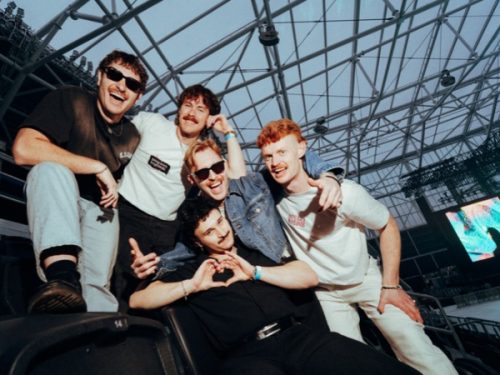 On Spotify and elsewhere Castaway hang out their e-shingle #bringbackboybands. Sure, they all sport matching Castaway-chic moustaches, but they’re not a trad boy band at all, so what’s that messaging?
“It’s a bit tongue in cheek,” acknowledges Austen to shared laughter.
“It’s about the essence and the ethos of boy bands,” Jack offers. “If you go right back to like, you know, The Beatles or all those other bands that have come since, right the way up to One Direction and 5 SoS in the modern era, everybody is an individual character. And that gets a lot of emphasis – and you know, gets a lot of spotlight. But also, you become something greater than the sum of your parts when you become a boy band.
“We started as mates at uni, and that means we’re all individual characters, but we’d like to become something bigger than just our individual personas and personalities. That’s mostly what the boy band thing means for us. You don’t have to be 19 with no facial hair to be in a boy band. It’s about creating something fun and exciting as a unit.”
Though none originally hail from Christchurch, Castaway have very much made the city their home. After the 2021 release of their self-recorded first EP, ‘Chaos & Order’, they had a weekend away in Le Bon’s Bay. Jack says it was then they all agreed they were really going to commit to this band thing and see where it could go. Jackson Stewart, the other big-voiced lead vocalist, had been taking singing lessons with Sasha Vee, and Castaway decided to sign on to the former pop star’s SOLE Music Academy Artist Development program in 2022.
“That course taught us so much about the music industry, about music business, as well as pushing our limits of creativity and artistry on stage and in songwriting. It was a full year, and we then got selected to take part in the artist release program, which meant Sasha supported us to release our next body of work – the ‘Nondual’ EP which had singles that came out throughout 2024 and ’25.”
All five get credited as composers on their songs, and with that many multi-instrument enthusiasts learning to compose together it’s easy to imagine songwriting chaos ensuing. Jack concurs with laughter.
“I think when we started writing songs it was probably an offshoot of our ‘let’s jam in our hall rooms together and just have a bit of fun as mates’ approach, and that extended into songwriting that was equally chaotic and collaborative.
“We always wrote songs together because that’s what we love doing. We love being around each other and playing music, and that meant we started with songs that were coming from each individual’s perspective of what a song could be, and what a sound could be for Castaway.
“I guess over time, and with the support of all the amazing musicians we’ve been connected with over the years, we’ve started to find our strengths in the songwriting process.”
He explains that means instead of all of them trying to write a song end to end, they’ve developed a process where everyone gets to input in ways they feel they can contribute the most.
“That’s allowed us to be flexible and creative in a different way. So while I might not have been a songwriter per se at the start I always wrote poetry when I was younger, so that leans nicely into the lyrics. But it’s not as much of a strength for me to and write all the guitar chords for a song. Jackson or Rhys are really, really good at that. So, yeah, we’ve kind of developed this process that leans into everyone’s strengths.”
Greg Haver, the Welsh-Kiwi music producer who famously worked with Manic Street Preachers mostly produced the ‘Nondual’ EP’s seven tracks, which saw Castaway step boldly towards the polished Britpop realm, The Killers, Coldplay and The 1975 given as references for their sound. Joe credits Haver’s guidance then and since with helping them learn how to write and inclusively arrange the upbeat style of anthemic pop-rock they now exemplify.
“I don’t know about the other boys, but I certainly think that when we were writing to start with it was the case that we all wanted to play everything all the time, and it all just mashed together. A sound still comes out that’s maybe cool and enjoyable, but it definitely doesn’t allow the songs to breathe the way they potentially should.
“Through Greg’s mentorship we’ve learnt to do what’s best for the song, so now it’s not a case of everyone wanting to play all the time. But it is the case that, ‘Hey, I’m just happily going to sit this one out and let the song breathe.’ And that’s a beautiful part of it. Shout out to Greg Haver there for teaching us how to listen to music.”
They praise his production for helping them find sounds or effects they want without taking over, Joe observing that everything he brings to the table is an elevation of the song.
“But the song is ours. It’s still how we wanted it to be communicated, and that’s something I love about how we work together. Letting him run creatively at the same time as us being able to do the same thing is where the music meets and the magic happens. So those two things go hand in hand.”
Unsurprisingly then ‘Somewhere In Between’ was also produced by Haver, and mixed by Clint Murphy. With recording spread out over 20 days and nearly 12 months, the tracks were mostly recorded at The Lab in Auckland with a brief stint in the main Parachute studio to bring it all home. Jack points out the project’s first recording session in February 2025 resulted in just two songs, Feel Like Falling and Who Am I, which have become the opening and closing tracks of the album.
“That’s all we had at the time! And in in a funny way we kind of wrote the first page and the last page – then just kind of filled out the rest of the book in the future sessions. It took us two or three days in the first session to do two songs, and then in the last session we did nine songs in six days!
“Scott Seabright was our recording engineer and just an absolute maestro. So good. It was almost like our teamwork, and how synced up we were mentally, was the thing that was different between those sessions – and now we have 15 whole songs. Like that’s a lot of songs.”
He’s not wrong. ‘Somewhere In Between’ is a lot of songs, nearly 50 minutes-worth of exuberant, often naggingly familiar danceable ’80s synth-pop and energised alternative rock. Think Sam Fender meets The 1975 they helpfully suggest.
“We tried to trim the last recording session down,” Jack says in explanation of the long tracklist. “We were choosing between these nine songs, thinking, ‘We can only record eight, there’s no way we’ll be able to record nine.’ And after about three separate meetings, umming and ahhing, we kind of looked at each other and said, ‘Let’s just record all nine and see what happens.’
“This is probably not best practice, but we were writing lyrics and melodies and structural stuff right up until the last minute on the last day. But that’s the magic of working with a great team, it always somehow all comes together.
“We have a band saying which applies to touring and songwriting and things like this as well, which is, ‘nothing goes to plan, but everything works out’. And this album, and especially that last recording session, definitely feels in line with that.”
If things do go to plan then ‘Somewhere In Between’ is Castaway’s ticket to ahhm, cast away, as Austen reveals in a you-heard-it-here-first moment.
“This is going to be a huge step for us because following its release, we’re going to be committing to doing the band full time. So it’s kind of a turning point for us where it’s like, ‘Okay, we’ve been building this thing for the last eight years. We have got this awesome piece of art that we are super proud of, and we need to get it out there.’
“We need to give it 100% of our attention and our efforts, so that’s kind of what’s up next for us. We’ve been very fortunate to land a placement at Electric Avenue next year, it will kind of give a nice platform to step off on with the album. And following that we will be ripping into a tour and everything. And after that… worldwide.”
Austen credits the album title to Jackson, explaining it arrived as the last puzzle piece of the album.
“We had all the songs and everything, and then the title came afterwards. We knew what we wanted to write the album about. We had that really clear, and it was becoming more clear as the songs progressed and everything emerged, as the picture was painted.
“But I think we hadn’t quite found the way to express that in a title, and then ‘Somewhere In Between’ popped up, and just felt really fitting. Talking about these stages of transition going from adolescence to adulthood, and that awkward in-between where we’re figuring things out. Sometimes we feel like we’ve got it all under control and it’s amazing, and then something else pops up and you lose a grip on reality. Yeah, forever finding your way, that was where it came from.”
“I like your picture analogy,” Joe adds in support. “It’s almost like we had to paint the picture before we knew what to call it in some ways. We’d written all the songs, they were all mixed and mastered, and then we listened to them… and that’s when the idea for ‘Somewhere In Between’ came.
“It’s kind of clear now that’s the thread that ties all of the stuff together. While we knew the themes of the music and the songs that we wanted to write, the name kind of emerged right at the end of the process.”
This is a band who seem to enthusiastically work in concert, on stage as well as off it. The profile hike of Castaway in recent years is testimony to their self-management skills, but they each have full time professional career jobs – and now an album to promote. The pressure to step things up must be building?
“We’re definitely at a point of change, because we’ve been at this for eight years and we have such an amazing foundation,” Joe acknowledges. “We talk about how we’ve set a foundation of concrete between us; the trust, the camaraderie, the brotherhood, the alignment on the vision of what Castaway is and could become, and that’s something we’re super proud of.
“And certainly, we’re thinking about the next steps for us in terms of becoming an internationally recognised touring act, playing shows overseas, connecting with people all over the world – and management seems like one of the key enablers for that.
“We do a great job of managing ourselves because we can nail some emails, we can nail some spreadsheets, we can figure out finances. But we’re really looking to take this thing a lot bigger than what it is, and we really can see the value of management to help achieve that.
“Because this is what we want to do with our time on Earth; to play music with the boys and connect with people all over the world, and yeah, just make people’s days better through music. Like, what a life! What a life!”
Made with support from NZ On Air